

What AI Still Can’t Do (And Why That’s Where Your Income Is)
Almost every article about artificial intelligence and work is a prediction. This one is about measurements — because what AI can’t do turns out to be far more interesting, and far more useful, than another forecast about what it might do someday.
Since late 2022, the public conversation has run on projections. Some studies suggested that most office work could be automated. Headlines followed. Career advice followed the headlines.
But we’re now several years into actual adoption, which means there’s something better than speculation available: data on what has really happened to employment, task by task, occupation by occupation.
That data tells a story almost nobody is telling. And it points, quite specifically, at where human work still holds its value.
The Gap Between What AI Could Do and What It Actually Does
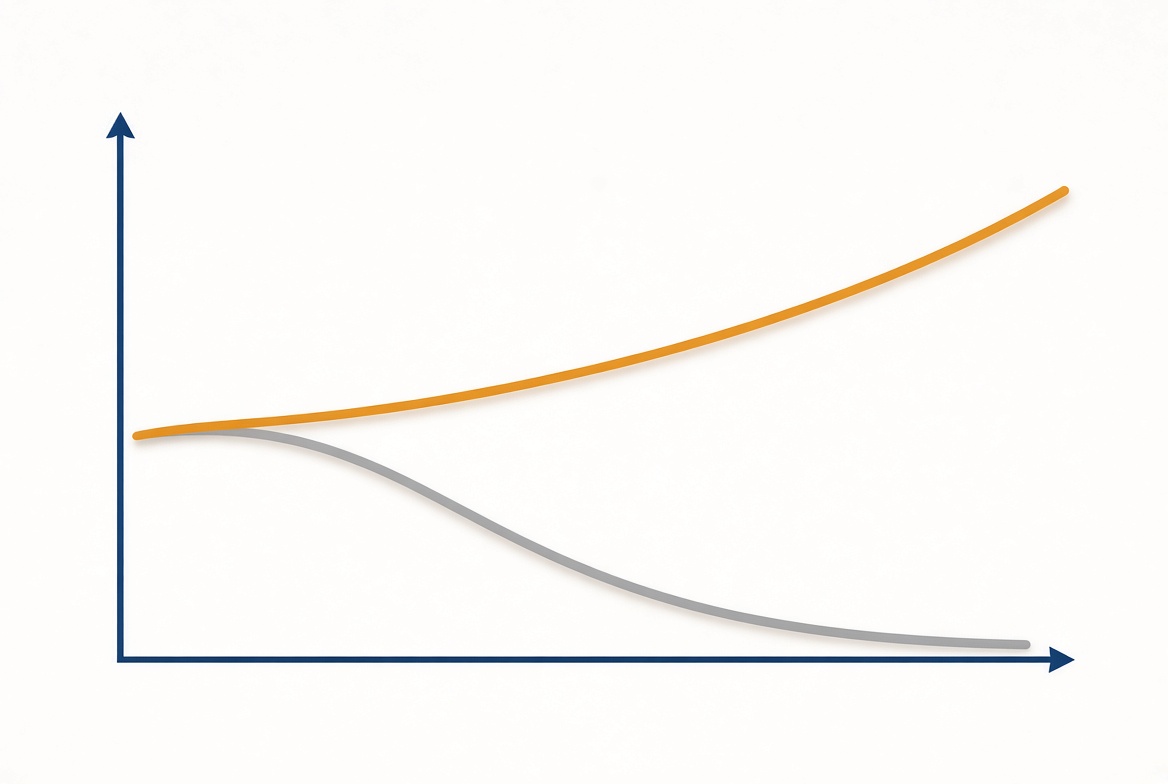
The most important finding in recent labor research isn’t about capability. It’s about the distance between capability and use.
Researchers have started distinguishing between theoretical exposure — the share of an occupation’s tasks a language model could plausibly handle — and observed exposure, which measures what people actually delegate to these tools in practice.
The gap is enormous. According to Anthropic’s research on labor market impacts, AI remains far from reaching its theoretical capability, with actual coverage representing only a fraction of what is technically feasible.
Even in the occupations most affected, the numbers fall short of the automation narrative. By the observed measure, computer programmers sit at roughly 75% task coverage and customer service representatives at around 70% — high, certainly, but well below the near-total replacement that theoretical studies implied.
That distinction matters more than any prediction. Capability is not adoption. And adoption is where careers actually live or die.
What the Employment Data Actually Shows
Here is where the story gets genuinely surprising.
Analysis from the Yale Budget Lab found that employment in high-AI-exposure occupations grew by 1.7% between mid-2024 and late 2025. Not shrank — grew.
Meanwhile, tracking by outplacement firm Challenger, Gray & Christmas attributed roughly 55,000 U.S. job losses to AI in 2025. That sounds like a lot until you see the denominator: it represented about 4.5% of total job losses that year.
The same pattern shows up in official projections. The Bureau of Labor Statistics projects that software developers — an occupation supposedly first in line for replacement — will grow 15.8% over the 2024–34 period, adding more than 267,000 jobs.
None of this means AI has no effect. The BLS occupational projections overview likewise finds that occupations with higher exposure are projected to grow more slowly than others. Slower growth is real. But slower growth and disappearance are not the same thing.
| Measure | What It Claims | What It Actually Found |
|---|---|---|
| Theoretical exposure studies | Most office tasks are automatable | Capability estimates, not usage |
| Observed exposure (2026) | Real-world delegation to AI | Far below theoretical ceiling |
| Yale Budget Lab employment data | High-exposure jobs would shrink | Grew 1.7% mid-2024 to late 2025 |
| Challenger layoff tracking | AI is driving mass layoffs | ~4.5% of 2025 job losses cited AI |
| BLS occupational projections | Tech roles collapsing | Software developers +15.8% to 2034 |
Why the Predictions Missed
There’s a structural reason the forecasts overshot, and understanding it explains most of what follows.
Exposure studies measure tasks. Employment happens in jobs. A job is a bundle of tasks plus responsibility, context, relationships, and accountability — and that bundle rarely automates cleanly.
Boston Consulting Group’s analysis of the same question reached a similar conclusion: task automation does not equal job loss, and most roles remain in place while changing substantially in composition.
There’s also a constraint that pure capability analysis ignores entirely. Even where automation is technically possible, expansion runs into capital requirements, licensing rules, regulatory approval, credentialing barriers, and training pipelines that take years to move.
The technology moved fast. The institutions around the work did not.

What AI Can’t Do: Four Categories That Hold Their Value
Reading across the research, the tasks that resist delegation cluster into four recognizable groups. This isn’t a list of safe job titles — it’s a list of characteristics that make work hard to hand off.
Work requiring physical presence. Research on task-level exposure patterns consistently finds that occupations dependent on manual labor or in-person interaction show minimal AI use. Not low use — minimal. This is the most durable category, and it’s frequently ignored by career advice aimed at knowledge workers.
Work carrying accountability. Someone has to sign the document, approve the budget, take the liability, and answer for the outcome. AI can draft the recommendation. It cannot hold the responsibility, and organizations are structurally unwilling to let it try.
Work built on trust and relationship. Negotiation, client retention, difficult conversations, and long-term partnership all depend on a specific human being that another human being has decided to rely on. That transfers poorly to a tool.
Work in genuinely novel context. Language models are strongest where patterns exist in their training data. Situations without precedent — a new market, an unusual failure, an unprecedented combination of constraints — still require someone to reason from first principles.
The One Warning Sign Worth Taking Seriously
If you take a single caution from the data, take this one.
The same research that found no systematic unemployment increase among highly exposed workers did find suggestive evidence that hiring of younger workers has slowed in exposed occupations.
This is the real shift, and it’s much more specific than “AI is taking jobs.” It suggests that the entry-level rung — the tasks juniors traditionally used to build competence — is thinning.
Historically, a junior analyst learned by producing first drafts. A junior developer learned by fixing small bugs. Those are precisely the tasks now being delegated to tools.
The result isn’t mass displacement of experienced workers. It’s a harder path into the profession for people starting out, which is a genuinely different problem requiring a genuinely different response.
Where This Leaves Your Income
If the durable categories are physical presence, accountability, trust, and novel reasoning, the practical question becomes: how do you position yourself closer to them?
Three moves come out of the data rather than out of motivational advice.
Move toward judgment, away from production. The person who decides what should be built and why holds a different position from the person who produces the output. AI compressed the cost of production dramatically. It barely touched the cost of good judgment.
Build relationships that belong to you. Client trust, professional reputation, and a network that returns your calls are assets no tool replicates. They’re also slow to build, which is exactly why they hold value.
Use the tools rather than competing with them. The research repeatedly finds AI being used more as an augmenting tool than a replacement. Someone who produces four times the output with these tools isn’t competing with them — they’re pricing themselves above people who don’t.
| Position | AI Pressure | Why |
|---|---|---|
| Pure content production | High | Directly delegated to tools today |
| Routine data processing | High | Pattern-matching work, easily replicated |
| Judgment and strategy | Low | Requires accountability and context |
| Client-facing relationship work | Low | Trust doesn’t transfer to a tool |
| Physical and in-person work | Very low | Minimal observed AI use |
| Novel problem-solving | Low | Weak training-data precedent |
Building any of these positions takes months of sustained effort, which makes it a question of systems rather than motivation. The people who manage it tend to design their week around the work rather than waiting to feel ready for it.

What This Means If You’re Starting Out
The entry-level squeeze is the part of this that deserves a direct answer rather than reassurance.
If the traditional junior tasks are being absorbed, the traditional path in is narrower. That’s not a reason for despair, but it is a reason to change approach.
The people navigating this well tend to skip the queue rather than wait in it. They build visible proof of capability — real projects, real clients, real output — instead of relying on a credential to open the door.
That logic favours building one deep, demonstrable skill over a broad but shallow profile. A portfolio of three real projects a hiring manager can open says more than a list of tools you have touched, and it sidesteps the credential queue entirely.
It also explains why independent income paths matter more now than they did five years ago. When the traditional entry point narrows, creating your own point of entry stops being an alternative route and starts being the main one.
The Honest Uncertainty
Any article claiming certainty about this topic is overselling, and it’s worth being explicit about the limits.
The data covers roughly three years of adoption. Capability continues to advance. The observed-versus-theoretical gap could narrow considerably, and some researchers expect it will.
The findings on younger workers are described by the researchers themselves as suggestive rather than conclusive. And measurement methods for this question are still actively being developed — the BLS itself has published work on improving how AI impacts get incorporated into employment projections.
What the data supports is narrower than the headlines but more useful: the sudden collapse hasn’t happened, the effect is real but concentrated, and the durable work has identifiable characteristics.
Frequently Asked Questions
Is AI actually causing mass unemployment right now? The measured evidence says no. Research found no systematic unemployment increase among highly exposed workers since late 2022, and employment in high-exposure occupations grew 1.7% between mid-2024 and late 2025.
Which jobs are genuinely most exposed? By observed measures, computer programmers sit around 75% task coverage and customer service representatives around 70%. Both remain well below full automation, and both occupations still employ millions of people.
Why did so many predictions turn out wrong? They measured what AI could theoretically do with individual tasks, not what organizations actually delegate. Jobs bundle tasks with accountability, relationships, and regulatory constraints that don’t automate cleanly.
Is it too late to enter a field like software development? The BLS projects software developer employment to grow 15.8% through 2034, adding over 267,000 jobs. The concern isn’t the field disappearing — it’s that entry-level positions appear to be getting harder to secure.
What kind of work is least affected? Occupations dependent on manual labor or in-person interaction show minimal AI use in the research. Physical presence remains the most durable category by a wide margin.
Should I learn to use AI tools or avoid them? The data shows AI being used predominantly as an augmenting tool rather than a replacement. Learning to use these tools well positions you above people who don’t, rather than in competition with the technology itself.
Could this change quickly? Possibly. Capability continues advancing and the gap between theoretical and observed use could narrow. The findings describe measured reality over roughly three years, not a permanent state.
Does this mean career advice about AI is useless? Not useless, but most of it is built on predictions rather than measurements. Advice grounded in what has actually happened tends to age better than advice built on forecasts.
Final Thoughts
Understanding what AI can’t do is more practically useful than tracking what it might eventually do, because the first question has answers you can act on today.
The measured picture is clearer than the headlines suggest. Automation of tasks has not translated into elimination of jobs at anything like the predicted rate. The effect is real, concentrated in specific occupations, and showing up most visibly in slower entry-level hiring rather than mass displacement.
The work that holds its value has consistent characteristics: it requires presence, carries accountability, depends on trust, or demands reasoning without precedent. Positioning yourself toward those characteristics is a more reliable strategy than trying to guess which job titles survive.
The people who do well through this transition probably won’t be the ones who predicted it correctly. They’ll be the ones who paid attention to what was actually happening while everyone else argued about what might.
A Note from Lucas
I started researching this expecting to write about which jobs were disappearing. What I found instead genuinely changed my mind — the measured employment data looks almost nothing like the headlines I’d been absorbing for two years. The gap between what these tools can do and what people actually hand to them was the detail that reframed the whole topic for me, and I hadn’t seen it discussed anywhere before I went looking. My honest opinion after going through the numbers: the panic is misplaced, but so is the dismissal, and the real story sits in an uncomfortable middle that doesn’t make for good headlines. If there’s one thing I’d tell anyone worried about this, it’s to check whether the source is measuring something or predicting something — that single question filters out most of the noise.
About the Author
Lucas Palma is the founder and editor of Info Is The Key. He researches and writes about work, money, and practical skills, digging into primary sources and data to turn complex topics into clear, usable information.
Last Updated: August 2026 | Reading Time: 11 minutes
Sources
- Anthropic, Labor Market Impacts of AI: A New Measure and Early Evidence (March 2026)
- U.S. Bureau of Labor Statistics, Artificial Intelligence, Information Technology, and Employment, 2024–34
- U.S. Bureau of Labor Statistics, AI Impacts in BLS Employment Projections
- Boston Consulting Group, AI Will Reshape More Jobs Than It Replaces (2026)
- U.S. Bureau of Labor Statistics, Industry and Occupational Employment Projections Overview, 2024–34






One Comment