
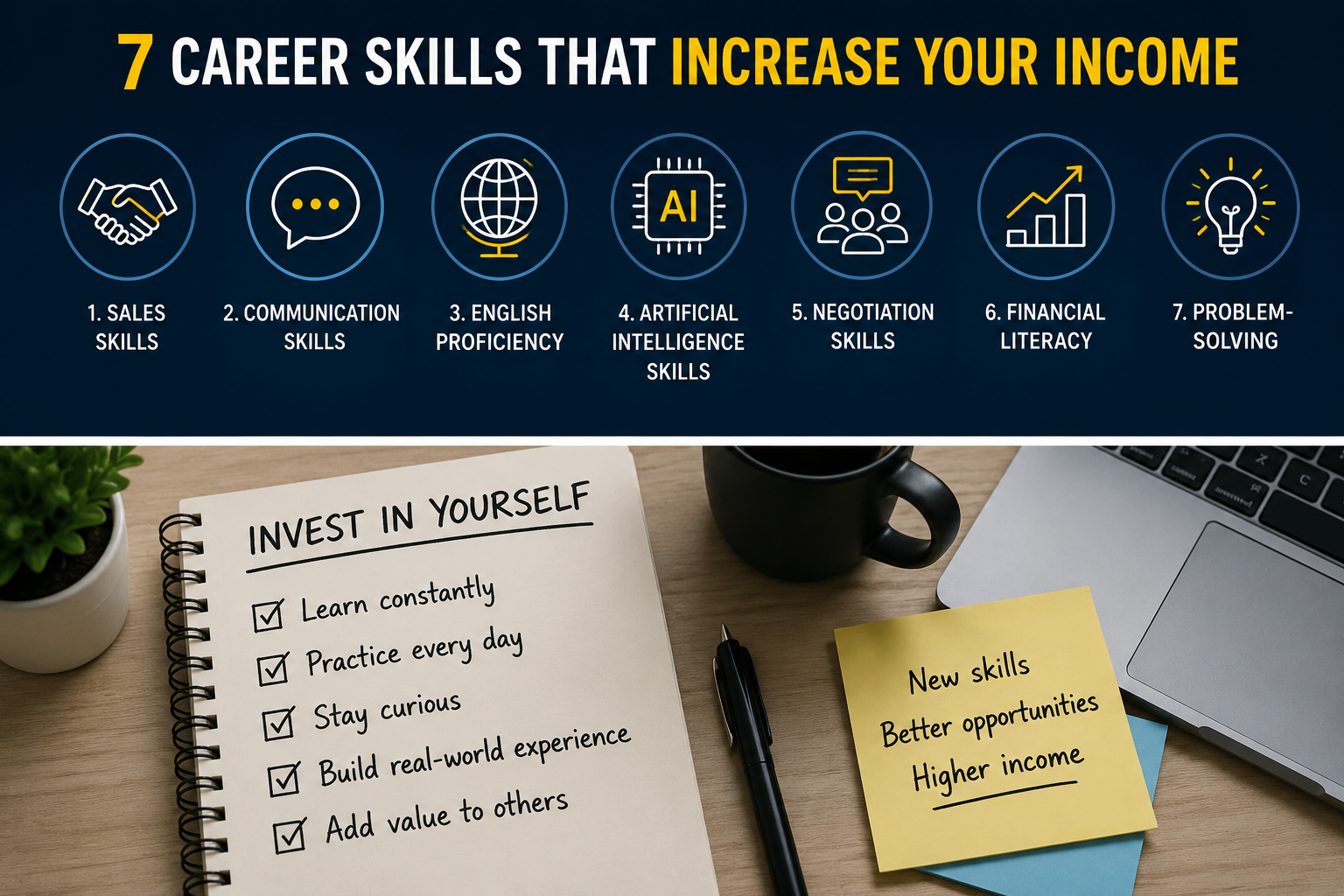
The Career Skills That Increase Your Income (And How to Build Them)
The career skills that increase your income rarely show up on a typical job description, and that’s exactly why so few people invest in them deliberately. In today’s rapidly evolving world, the rules of career growth are changing faster than ever. Technological advancements, artificial intelligence, remote work, and globalization are transforming industries and creating new opportunities for professionals willing to adapt.
While many people wait for a promotion or a better job posting, the highest earners tend to share one habit: they continuously invest in a small set of skills that transfer across roles and industries, rather than skills tied to one specific job.
The good news is that none of this requires another university degree. Mastering a handful of high-demand, transferable skills can meaningfully improve your career prospects, open doors to international opportunities, and help you build additional income streams alongside your main job.
This guide breaks down seven skills that consistently show up in what employers pay more for, why each one matters, and how to start building it — with specific resources rather than vague advice to “read more” or “practice.”
Why These Are the Career Skills That Actually Increase Your Income
The job market has become increasingly competitive. Companies are no longer paying employees simply for their time; they’re paying for results, problem-solving ability, and expertise that’s hard to replace.
As automation continues to absorb repetitive tasks, professionals who combine technical knowledge with genuinely transferable skills become harder to replace, not easier. These are the people who tend to see higher salaries, more career flexibility, and stronger job security when a given role or even an entire industry shifts.
This shift isn’t hypothetical. The World Economic Forum’s Future of Jobs Report 2025 found that employers now expect 39% of workers’ core skills to change by 2030, and leadership and social influence rank among the ten fastest-rising skills worldwide. Companies that once treated training as optional are responding accordingly: half of the global workforce has already completed some form of reskilling, up from 41% just two years earlier.
1. Sales Skills
Many people assume sales only applies to sales representatives or business owners. In reality, it’s one of the most universally valuable skills in any career.
Every job interview, salary discussion, internal pitch, or client conversation is a form of selling. People who understand sales know how to communicate value, build trust, and influence decisions — abilities that raise earning potential regardless of industry.
How to build it:
- Study a short, well-reviewed book on persuasion or consultative selling rather than generic “sales tips” content
- Shadow or ask questions of the strongest salesperson in your current company, even outside your department
- Practice framing your own work in terms of the problem it solves, not the tasks it involved
- Role-play a real upcoming negotiation or pitch with a colleague before it happens
2. Communication Skills
Communication affects every part of a career, which is exactly why it’s easy to underrate. You can have strong ideas, but if you can’t communicate them clearly, that value often goes unnoticed by the people who decide raises and promotions.
Strong communicators tend to be better at leading teams, resolving conflict, presenting ideas, and negotiating contracts — all of which employers consistently reward.
How to build it:
- Record yourself giving a five-minute update on a real project, then watch it back for filler words and unclear structure
- Join a local Toastmasters chapter or an equivalent public-speaking group for structured, low-stakes practice
- Rewrite one work email per week to be roughly 30% shorter without losing meaning
- Ask a trusted colleague for specific feedback after your next presentation, not just “how did that go?”
3. English Proficiency
English remains the dominant language of international business, science, and technology. Professionals who speak it fluently often gain access to international roles, higher-paying positions, and remote work with companies outside their home country.
This isn’t just anecdotal. Research summarized by the World Economic Forum found that in nearly every country studied, a rise in national English proficiency tracked with a rise in per capita income — and recruiters worldwide report that job seekers with exceptional English for their country earn 30 to 50 percent higher salaries than peers with weaker skills. For a genuinely international audience, that gap is hard to ignore.
How to build it:
- Watch content in English with English subtitles rather than subtitles in your native language, which trains listening comprehension faster
- Read one short article daily in your specific professional field, not general-interest content
- Use a structured app like Duolingo or Babbel for grammar consistency, paired with real conversation practice
- Join an online conversation group focused on professional or industry topics, not casual chat
Consistency matters far more than perfection here — a slightly imperfect but confident communicator usually outperforms a hesitant, “grammatically correct” one in real business settings.
4. Artificial Intelligence Skills
AI is already reshaping marketing, finance, healthcare, education, and customer service. Professionals who know how to use AI tools effectively can complete tasks faster and create more value for employers, without necessarily needing programming knowledge.
If you want a full breakdown of how to turn this specific skill into income, our guide on how to make money online with AI tools covers this in more depth, organized by category rather than by tool name, since the tools themselves change constantly.
How to build it:
- Pick one AI tool relevant to your current role and use it daily for two weeks on real tasks, not test prompts
- Learn prompt refinement — the skill of iterating a request until the output is genuinely usable, not accepting the first draft
- Follow how your specific industry is applying AI, rather than general AI news, since the applications vary enormously by field
5. Negotiation Skills
Negotiation shows up in salary discussions, business deals, contracts, and everyday purchases. According to Pew Research Center, only about 32% of men and 28% of women say they asked for higher pay the last time they were hired, even though most people who do ask receive at least part of what they requested. That gap represents real money left on the table by people who simply never asked.
How to build it:
- Before any negotiation, write down your specific number and your walk-away point in advance — not just a vague sense of “more”
- Practice asking open-ended questions that surface the other side’s actual constraints, rather than only presenting your own case
- Treat silence after making an offer as a tool, not something to fill with an immediate concession

6. Digital Marketing Skills
Businesses increasingly depend on the internet to attract customers, which keeps professionals with digital marketing expertise in consistent demand across SEO, content marketing, social media, email marketing, and paid advertising. The Bureau of Labor Statistics projects employment of advertising, promotions, and marketing managers to keep growing faster than the average for all occupations through the coming decade, driven largely by the continued shift toward digital and data-driven campaigns.
How to build it:
- Pick one channel (SEO, email, or paid ads) and go deep before spreading across all of them
- Run a small, real campaign — even for a personal project or a friend’s small business — rather than only studying theory
- Learn to read basic analytics dashboards, since the ability to interpret results is often what separates a marketer from someone who just posts content
7. Leadership Skills
Leadership is often reduced to “managing employees,” but it’s really the ability to inspire, guide, and influence others toward a shared goal — a skill that matters long before anyone has direct reports.
How to build it:
- Volunteer to lead one small, low-stakes project outside your formal job description
- Ask for feedback specifically on how you handled a disagreement or setback, not just on your results
- Study how a leader you respect makes decisions under uncertainty, and note the specific questions they ask
Skill Comparison: Learning Curve vs. Income Impact
| Skill | Typical Learning Curve | Where the Income Impact Shows Up Fastest |
|---|---|---|
| Sales | Moderate | Freelance clients, internal promotions |
| Communication | Moderate | Leadership visibility, client trust |
| English Proficiency | Long-term | International and remote job access |
| Artificial Intelligence | Fast | Productivity-based raises, freelance rates |
| Negotiation | Short, high-leverage | Salary offers, contract terms |
| Digital Marketing | Moderate | Freelance and entrepreneurial income |
| Leadership | Long-term | Promotions, management-track roles |

How to Choose Which Skill to Build First
Trying to develop all seven at once usually means making real progress on none of them. Match your first pick to your current situation instead:
If you work in customer service: start with communication, English, and sales.
If you work in technology: start with artificial intelligence, leadership, and communication.
If you want to start a business: start with sales, digital marketing, and negotiation.
Mastering one skill before moving to the next consistently produces faster, more visible results than spreading effort thin across all seven at once. Once you have a skill that’s paying off, our guide to how to build a high-income skill in 2026 covers how to go deeper and turn that foundation into a larger income shift, and our step-by-step guide to making your first $1,000 online shows how to apply these same skills toward independent income rather than only a raise from an employer.
What These Skills Have in Common
An interesting pattern connects all seven: they’re highly transferable. Unlike narrow technical skills that can become obsolete as tools change, these abilities remain useful across industries and career paths — whether you work in hospitality, technology, healthcare, finance, or entrepreneurship.
They also compound. Combining communication, sales, leadership, and AI fluency tends to create a stronger competitive advantage than any one of them alone, since each skill makes the others more effective in practice. If your schedule is tight and you want to practice one of these skills in a low-stakes way, several of our side hustles you can start this weekend with no money double as real-world practice for sales, communication, or digital marketing.
Frequently Asked Questions
Do I need to master all seven skills to see a real income difference? No. Most people see a measurable difference from developing just one or two of these skills deeply, especially negotiation and communication, which tend to have the fastest visible payoff.
Which skill has the fastest return on the time invested? Negotiation typically has the shortest learning curve relative to its financial impact, since a single successful salary or contract negotiation can be worth more than months of incremental skill-building elsewhere.
Can I develop these skills without spending money on courses? Yes. Every skill above has a free or low-cost path — free AI tool tiers, public speaking groups, free language exchange apps, and real on-the-job practice all work without a paid course.
Is artificial intelligence really a “skill,” or just a tool? Using AI tools effectively is a skill in the same way using spreadsheets or search engines is a skill — the tools are widely available, but knowing how to apply them well to a specific job is what actually creates value.
How long does it typically take to see income results from these skills? It varies widely by skill. Negotiation can pay off in a single conversation, while English proficiency and leadership tend to compound gradually over months or years rather than producing an immediate jump.
Should I list these skills on my resume even if I’m still developing them? Only list a skill once you can give a specific, concrete example of using it — a vague bullet point without evidence behind it can do more harm than good in an interview.

Final Thoughts
Taken together, these are the career skills that actually increase your income in a way most one-off advice never captures, because they compound instead of expiring. The future belongs to people who keep learning and adapting rather than waiting for their existing skill set to stay relevant on its own. Sales, communication, English proficiency, artificial intelligence, negotiation, digital marketing, and leadership consistently show up in what employers and clients are willing to pay more for, because each one helps solve problems, build trust, or create measurable value.
Rather than trying to develop all seven at once, pick the one that matches where you are right now, and commit to consistent, deliberate practice rather than passive learning. Small, specific progress compounds — often faster than people expect once they actually start.
About the Author Lucas is the founder and editor of Info Is The Key. He researches and writes across money, world affairs, and practical skills, turning that research into clear, actionable information readers can use right away.
Last Updated: August 2026 | Reading Time: 10 minutes
Sources
- Pew Research Center, When Negotiating Starting Salaries, Most U.S. Women and Men Don’t Ask for Higher Pay
- U.S. Bureau of Labor Statistics, Advertising, Promotions, and Marketing Managers
- World Economic Forum, Future of Jobs Report 2025
- World Economic Forum, The Link Between English and Economics