
For thousands of years, the Egyptian pyramids have stood as one of the most fascinating structures ever built by human hands. Rising from the desert sands of Giza, these massive stone monuments have inspired countless legends, conspiracy theories, and unanswered questions. But how much of what we “know” about the Egyptian pyramids is actually true, and how much is myth built up over centuries of speculation?
In this article, we separate historical fact from popular fiction, exploring who really built the pyramids, how they were constructed, and why they continue to capture the world’s imagination today.
What Are the Egyptian Pyramids?
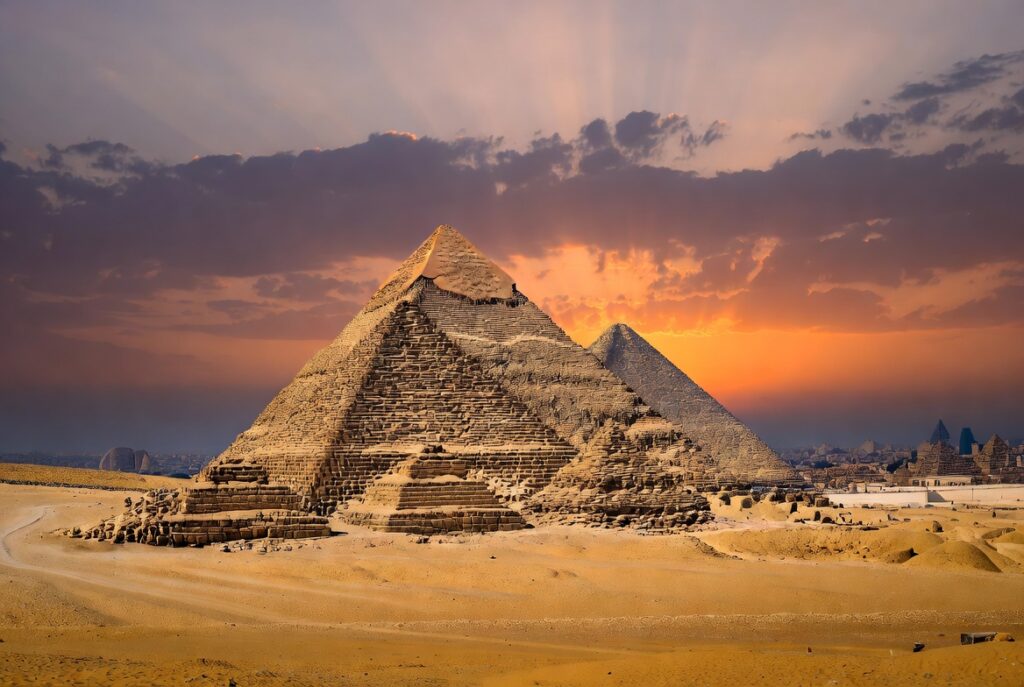
The Egyptian pyramids are massive stone tombs built during the Old and Middle Kingdoms of ancient Egypt, primarily to house the remains of pharaohs and prepare them for the afterlife. Ancient Egyptians believed that a pharaoh’s soul needed a permanent, indestructible resting place, and the pyramid shape was thought to help the ruler’s spirit ascend toward the heavens.
The most famous of these structures are found in Giza, just outside modern-day Cairo: the Great Pyramid of Khufu, the Pyramid of Khafre, and the smaller Pyramid of Menkaure. Of these, the Great Pyramid of Giza is the oldest and largest, and it remains the only surviving structure among the original Seven Wonders of the Ancient World.
Myth #1: Aliens Built the Pyramids
Perhaps no myth about the Egyptian pyramids is more persistent than the idea that ancient humans simply couldn’t have built them without extraterrestrial help. This theory gained popularity in the 20th century through books and television specials, but archaeologists and engineers have thoroughly debunked it.
Excavations at workers’ villages near Giza have uncovered bakeries, bread molds, tools, medical records, and even the burial sites of the laborers themselves. These findings prove that the pyramids were built by skilled, organized human workers — not slaves, and certainly not aliens.
Myth #2: The Pyramids Were Built by Slaves
Popular culture, largely influenced by Hollywood films and biblical interpretations, has long portrayed the pyramid builders as enslaved people forced into labor under brutal conditions. However, archaeological evidence tells a different story.
Skeletal remains and worker settlements discovered near the Giza pyramids suggest the builders were paid laborers, likely farmers who worked during the Nile’s flood season when their fields were underwater. Workers received rations of bread, beer, and meat, and were buried in proper tombs close to the pyramids they helped build — an honor unlikely to be given to slaves.
How Were the Pyramids Actually Built?
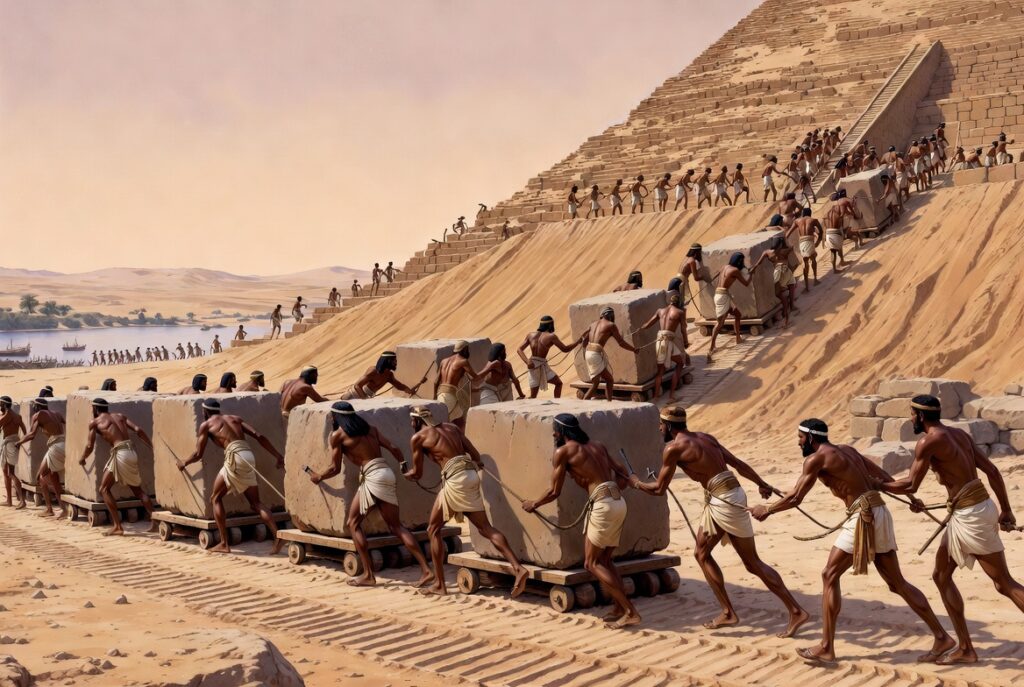
This remains one of the greatest engineering mysteries of the ancient world. The Great Pyramid alone contains an estimated 2.3 million stone blocks, some weighing as much as 80 tons. Researchers believe workers used a combination of ramps, sledges, levers, and human labor to move and stack these enormous stones with remarkable precision.
Recent discoveries have provided new insight into pyramid logistics. In 2013, French archaeologist Pierre Tallet uncovered ancient papyri at the Red Sea port of Wadi al-Jarf, including a detailed logbook kept by an official named Merer. The diary describes how Merer’s crew transported limestone blocks by boat from the Tura quarries to the Giza construction site during the final years of Khufu’s reign, offering rare, firsthand evidence of how materials reached the pyramid complex nearly 4,500 years ago.
Despite these findings, many details about the exact construction techniques remain debated among Egyptologists, keeping the pyramids a subject of ongoing research and fascination.
The Engineering Theories Behind the Pyramid’s Construction
Even with modern evidence like the Diary of Merer confirming how limestone blocks reached Giza by boat, one enormous question remains fiercely debated among Egyptologists and engineers: how were these multi-ton blocks actually lifted and stacked into place, layer after layer, to form a structure that reaches over 140 meters into the sky?
Several competing theories attempt to explain this feat. The most widely accepted is the “ramp theory,” which suggests workers built massive earthen or rubble ramps that spiraled around or extended in front of the pyramid, allowing teams to drag stone blocks upward on wooden sledges, likely lubricated with water or wet sand to reduce friction. Archaeologists have found remnants of ramps at various pyramid construction sites, lending credibility to this idea, though no single ramp design has been definitively proven to explain the Great Pyramid specifically.
A more recent theory, proposed by French architect Jean-Pierre Houdin, suggests an internal spiral ramp built into the pyramid itself, hidden from view and used only during construction before being sealed off. Houdin’s theory gained attention after scans using cosmic-ray imaging (muon tomography) revealed previously unknown voids inside the Great Pyramid, though experts still disagree on whether these spaces support his specific model or represent something else entirely, such as relieving chambers designed to redistribute weight.
Other researchers point to simpler explanations rooted in large-scale human coordination rather than exotic engineering. With an estimated workforce of 20,000 to 30,000 laborers organized into specialized teams, historians argue that sheer manpower, combined with levers, copper tools, and precise surveying methods, may have been sufficient to move and place stones with the observed accuracy, without requiring any single “secret” technique.
What all these theories share is a growing consensus: the pyramids were not built through mysticism or forgotten technology, but through remarkable logistical planning, mathematical understanding, and organized labor on a scale rarely matched in the ancient world.
For more verified historical details, National Geographic offers an in-depth look at the Diary of Merer discovery, confirming how the pyramids were truly built.
Myth #3: The Pyramids Are Perfectly Aligned by Coincidence
Many people are surprised to learn that the Great Pyramid of Giza is aligned with the cardinal points of the compass with extraordinary precision — a feat that would be impressive even with modern tools. This has fueled speculation about “lost” ancient technology.
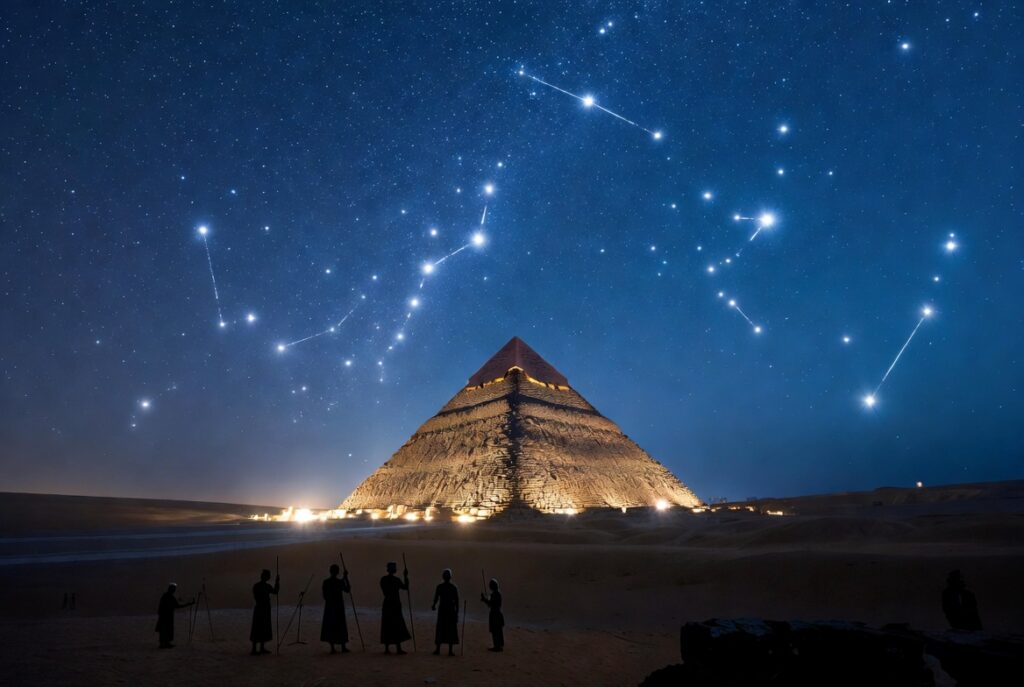
In reality, historians believe the Egyptians used simple but clever astronomical methods, such as tracking the rising and setting points of stars, to achieve this alignment. Their sophisticated understanding of astronomy, geometry, and surveying — not mysterious lost technology — allowed them to reach this level of precision.
The Religious and Symbolic Meaning of the Pyramid Shape
Beyond their engineering marvel, the pyramids held deep religious significance for ancient Egyptians, and understanding this symbolism helps explain why such enormous resources were dedicated to their construction in the first place.
At the center of this belief system was the sun god Ra, one of the most important deities in ancient Egyptian religion. The pyramid’s triangular shape is widely believed to represent the rays of the sun descending to Earth, or alternatively, a physical staircase allowing the pharaoh’s spirit to climb toward the heavens and join Ra in the afterlife. This connection between the pyramid shape and solar worship is reinforced by the “benben stone,” a sacred, pyramid-shaped relic believed to be the first solid mound to emerge from the waters of creation in Egyptian mythology. Many pyramids were originally capped with a similar stone, called a “pyramidion,” often covered in gold or electrum to reflect sunlight dramatically.
The pyramid’s precise alignment with the cardinal directions also carried spiritual weight, as ancient Egyptians associated the north with eternity and the circumpolar stars, which never set below the horizon, symbolizing immortality. Pharaohs were believed to journey toward these “imperishable stars” after death, and the pyramid served as the launching point for that eternal voyage.
Interior design choices reinforced this symbolism as well. Narrow shafts within the Great Pyramid, once thought to be purely for ventilation, are now believed by many researchers to have been deliberately aligned with specific stars, including Orion’s Belt (associated with the god Osiris) and Sirius (associated with the goddess Isis), reinforcing the idea that the pyramid functioned as a cosmic gateway rather than a simple tomb.
This fusion of architecture and belief demonstrates that the pyramids were never just monuments to power, but sacred instruments designed to secure a pharaoh’s place in the eternal order of the universe.
Why Do the Pyramids Still Matter Today?
Beyond their engineering marvel, the Egyptian pyramids offer a window into how ancient civilizations organized labor, religion, government, and resources on a massive scale. They reflect a society capable of extraordinary planning, coordination, and belief systems that shaped Egyptian culture for millennia.
The pyramids also continue to drive modern tourism, archaeology, and scientific research. New scanning technologies, such as muon tomography, have recently revealed previously unknown voids and chambers inside the Great Pyramid, proving that even after thousands of years, these structures still hold secrets waiting to be uncovered.
This blend of ancient mystery and modern innovation is part of why the Egyptian pyramids remain endlessly fascinating — much like other historical topics <a href=”https://infoisthekey.com/artificial-intelligence-chatgpt-future-of-work/“>where ancient ingenuity and modern breakthroughs continue to intersect.
Final Thoughts
The Egyptian pyramids are far more than piles of stone in the desert — they are a testament to human ambition, ingenuity, and belief. While myths about aliens and enslaved masses persist in popular imagination, historical and archaeological evidence paints a much richer picture: one of skilled workers, advanced planning, and a civilization determined to defy time itself.
As new research continues to emerge, our understanding of how — and why — the pyramids were built keeps evolving, proving that even 4,500 years later, ancient Egypt still has stories left to tell.
Sources consulted for factual accuracy include archaeological findings from Giza worker settlements and ancient papyri discoveries documented by Egyptologist Pierre Tallet.
If you’re fascinated by history’s greatest turning points, don’t miss our article on World War II: Key Events That Shaped the Modern World, where we explore another defining chapter of human history.