
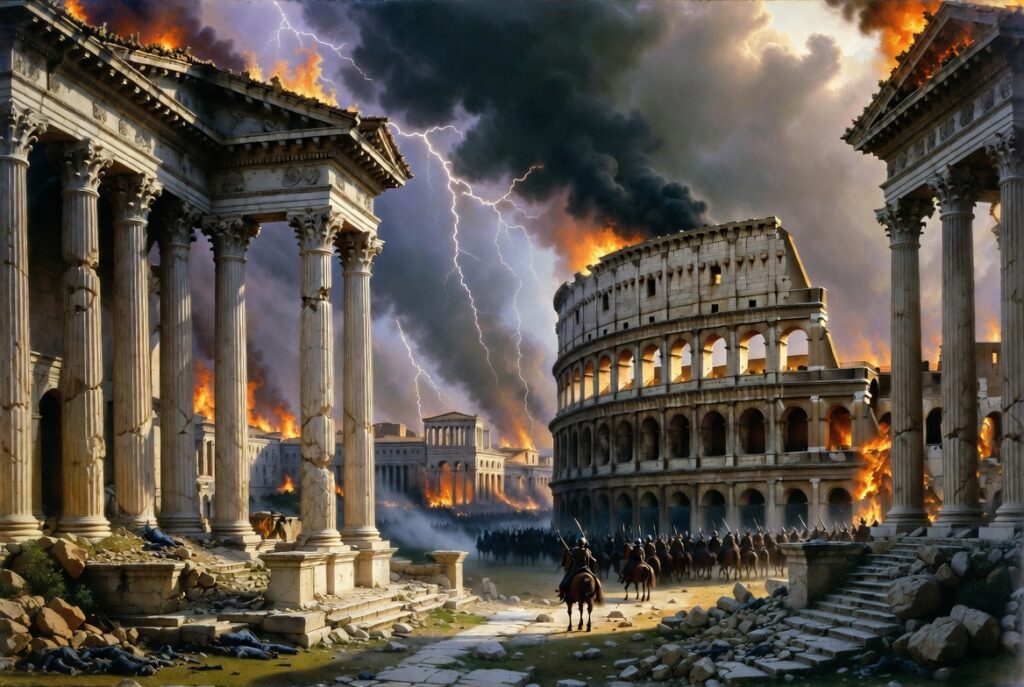
The Fall of the Roman Empire is one of the most studied and debated events in human history. In 476 AD, the last Western Roman emperor, Romulus Augustulus, was deposed by the Germanic leader Odoacer, marking the official end of the Western Roman Empire. However, the Fall of the Roman Empire was not caused by a single event. Instead, it was the result of a long and complex process of decline that unfolded over several centuries.
For more than 500 years, Rome dominated vast territories across Europe, North Africa, and the Middle East. Its achievements in law, engineering, military strategy, and governance shaped the foundations of Western civilization. Yet even the most powerful empire of the ancient world could not escape internal weaknesses and external pressures.
This article explores the main causes of the Fall of the Roman Empire, the key events that led to its collapse, and the important lessons that modern societies can learn from Rome’s decline.
The Glory Days: Rome at Its Peak
At its height during the reign of Emperor Trajan (98–117 AD), the Roman Empire was the most powerful civilization on Earth. Its territory stretched from Britain in the north to Egypt in the south and from Spain to Mesopotamia in the east.
Roman engineers built extensive road networks, aqueducts, bridges, and cities that connected millions of people.
Readers interested in exploring the broader history, expansion, and legacy of Rome can learn more through the Encyclopaedia Britannica’s comprehensive overview of the Roman Empire.
Trade flourished across the Mediterranean, while Roman law provided a common legal framework throughout the empire.
This period, known as the Pax Romana or “Roman Peace,” brought relative stability and prosperity for nearly two centuries. However, maintaining such a vast empire required enormous military, administrative, and economic resources.
By the third century AD, the first signs of decline had begun to emerge.
Main Causes of the Fall of the Roman Empire
Historians generally agree that there was no single cause behind the Fall of the Roman Empire. Instead, multiple factors combined over time to weaken Rome’s ability to govern and defend itself.
1. Barbarian Invasions and Military Overstretch
One of the most visible causes of the Fall of the Roman Empire was the increasing pressure from barbarian tribes.
Beginning in the late fourth century, groups such as the Visigoths, Ostrogoths, Vandals, Franks, and Huns crossed into Roman territory. These migrations were partly triggered by the westward expansion of the Huns, which displaced numerous populations.
In 410 AD, the Visigoths led by King Alaric successfully sacked the city of Rome. Although the city was no longer the empire’s political capital, the event shocked the Roman world and symbolized the empire’s growing vulnerability.
The Roman army had become overstretched defending thousands of miles of borders. To compensate for manpower shortages, Rome increasingly recruited barbarian mercenaries whose loyalty was often uncertain.
As military effectiveness declined, Rome became less capable of responding to external threats.
2. Economic Decline and Heavy Taxation
Economic instability played a critical role in the Fall of the Roman Empire.
Maintaining the military, bureaucracy, and infrastructure of such a large empire required immense financial resources. Continuous warfare drained the treasury, forcing the government to increase taxes.
Heavy taxation burdened farmers and the middle classes while wealthy landowners accumulated more power and influence. Economic inequality widened throughout the empire.
Inflation became a serious problem as emperors reduced the silver content of coins to finance government spending. As confidence in the currency declined, trade suffered.
Rome’s economic system also relied heavily on slave labor. When territorial expansion slowed, the supply of slaves decreased, reducing productivity and limiting economic growth.
3. Political Instability and Corruption
Political instability severely weakened the empire.
During the Crisis of the Third Century (235–284 AD), Rome experienced decades of chaos. More than twenty emperors ruled during this period, and many were assassinated, overthrown, or killed in battle.
Frequent changes in leadership made long-term planning nearly impossible. Civil wars diverted resources away from defending the empire’s borders and damaged public confidence in government institutions.
Corruption also became widespread throughout the administration. Officials often prioritized personal gain over public service, further reducing governmental efficiency.
These problems made it increasingly difficult for Rome to respond effectively to crises.
4. Division of the Empire
In 285 AD, Emperor Diocletian divided the Roman Empire into Eastern and Western halves.
The decision was intended to improve governance and make administration more manageable. While the Eastern Roman Empire (later known as the Byzantine Empire) prospered for nearly another thousand years, the Western Empire faced growing challenges.
The Western provinces were generally poorer and more exposed to invasions. Over time, the imbalance between East and West increased.
The division did not directly cause the Fall of the Roman Empire, but it made the Western half more vulnerable to collapse.
5. Plagues, Climate Change, and Demographic Decline
Natural disasters and environmental changes also contributed to the Fall of the Roman Empire.
Several major epidemics devastated the population. The Plague of Cyprian and later outbreaks reduced the workforce, weakened the economy, and limited military recruitment.
Recent research also suggests that climate fluctuations, droughts, and cooler temperatures affected agricultural production in parts of the empire.
Food shortages became more common, creating additional social and economic pressures during a period when Rome could least afford them.
6. Social and Cultural Changes
Some historians argue that social and cultural changes played a role in Rome’s decline.
The rise of Christianity transformed many aspects of Roman society. Some scholars believe that traditional Roman values emphasizing military service and civic duty gradually weakened.
Others argue that growing inequality, declining civic engagement, and a loss of social cohesion contributed more significantly to Rome’s problems.
While historians continue debating the importance of these factors, there is broad agreement that societal changes affected the empire’s resilience.
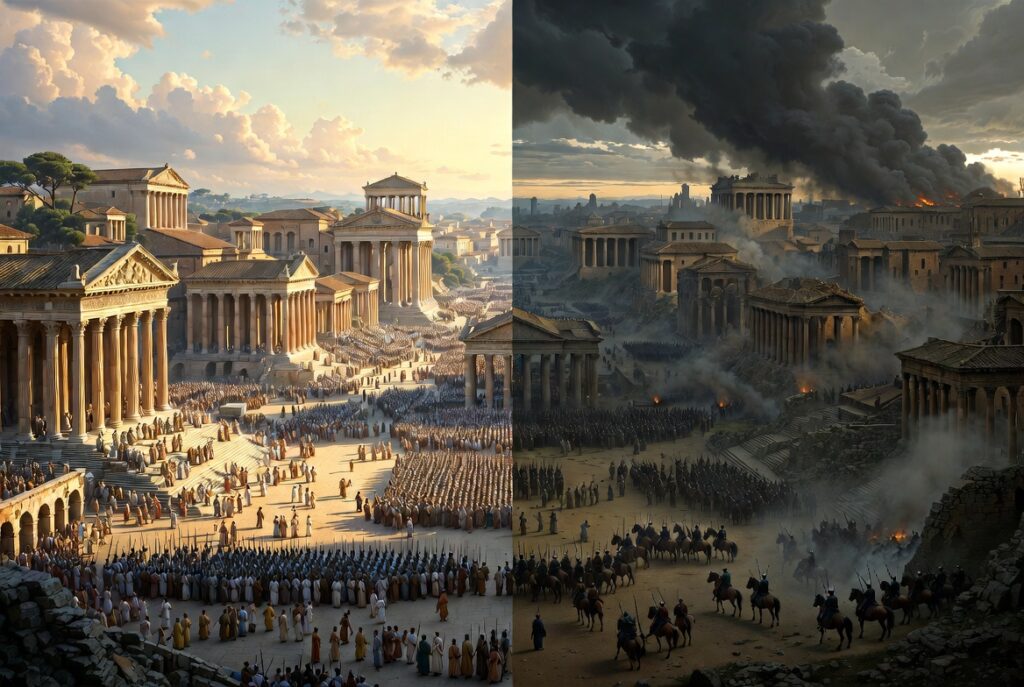
Timeline of the Fall of the Roman Empire
The Fall of the Roman Empire occurred gradually rather than through a single dramatic event.
Key Dates
- 235–284 AD: Crisis of the Third Century creates political instability.
- 285 AD: Emperor Diocletian divides the empire into Eastern and Western halves.
- 378 AD: Roman forces suffer a major defeat at the Battle of Adrianople.
- 410 AD: The Visigoths sack Rome.
- 455 AD: Rome is sacked again, this time by the Vandals.
- 476 AD: Romulus Augustulus is deposed by Odoacer, traditionally marking the end of the Western Roman Empire.
- 1453 AD: The Eastern Roman Empire falls when Constantinople is conquered by the Ottoman Empire.
These events illustrate how the decline unfolded over centuries rather than occurring suddenly.
Could the Roman Empire Have Been Saved?
Historians continue to debate whether the Fall of the Roman Empire was inevitable.
Some scholars argue that stronger leadership, economic reforms, and military modernization could have delayed or even prevented the collapse of the Western Empire. Emperors such as Diocletian and Constantine introduced important reforms that temporarily stabilized Rome, demonstrating that recovery was possible.
Others believe the empire had simply become too large and complex to govern effectively. The combination of political instability, economic decline, demographic challenges, and external invasions created pressures that no single ruler could permanently solve.
While the Eastern Roman Empire survived for nearly another thousand years, the Western Empire lacked the resources, unity, and institutional strength needed for long-term survival.
The debate remains relevant because many modern nations face similar challenges involving governance, economic management, military commitments, and social cohesion.
Lessons from the Fall of the Roman Empire for Modern Societies
The Fall of the Roman Empire offers valuable lessons that remain relevant today.
Overexpansion Creates Vulnerabilities
Managing vast territories requires enormous resources. When expansion exceeds a state’s capacity to govern effectively, stability becomes difficult to maintain.
Economic Inequality Can Undermine Stability
Growing inequality and excessive taxation can weaken public support and create social tensions.
Political Division Weakens Institutions
Frequent political conflict and corruption reduce trust in government and limit a nation’s ability to respond to crises.
Internal Problems Magnify External Threats
External enemies become far more dangerous when a society is already struggling with internal weaknesses.
Adaptability Is Essential
Successful societies must adapt to changing economic, technological, demographic, and environmental conditions.
Many observers draw parallels between Rome’s challenges and issues facing modern nations, including rising debt, political polarization, migration pressures, and military overextension.
Frequently Asked Questions About the Fall of the Roman Empire
Who was the last Roman emperor?
The last Western Roman emperor was Romulus Augustulus, who was deposed in 476 AD by Odoacer.
How long did the Roman Empire last?
The Roman Empire officially began in 27 BC under Emperor Augustus and lasted until 476 AD in the West. The Eastern Roman Empire survived until 1453 AD.
Did barbarian invasions alone cause the fall of Rome?
No. Most historians agree that invasions were only one factor. Economic decline, political instability, military challenges, demographic problems, and social changes all contributed to the Fall of the Roman Empire.
Why is the Fall of the Roman Empire still important today?
The Fall of the Roman Empire provides valuable lessons about leadership, governance, economic stability, and the resilience of civilizations.
The Lasting Legacy of the Roman Empire
Although the Western Roman Empire collapsed in 476 AD, its influence continues to shape the modern world.
Roman law inspired many legal systems used today. Latin evolved into several modern languages, including Spanish, French, Italian, Portuguese, and Romanian. Roman engineering innovations influenced infrastructure development for centuries.
Many concepts of government, military organization, urban planning, and citizenship also have roots in Roman civilization.
The legacy of Rome demonstrates that while empires may fall, their ideas and achievements can continue influencing humanity long after political power disappears.
Understanding the Fall of the Roman Empire therefore helps us understand not only how civilizations decline, but also how their contributions endure across generations.
Conclusion
The Fall of the Roman Empire remains one of history’s most important lessons about power, resilience, and decline. Rome’s collapse was not the result of a single invasion or one failed leader. Instead, it emerged from a combination of military pressures, economic problems, political instability, demographic challenges, and social changes that accumulated over centuries.
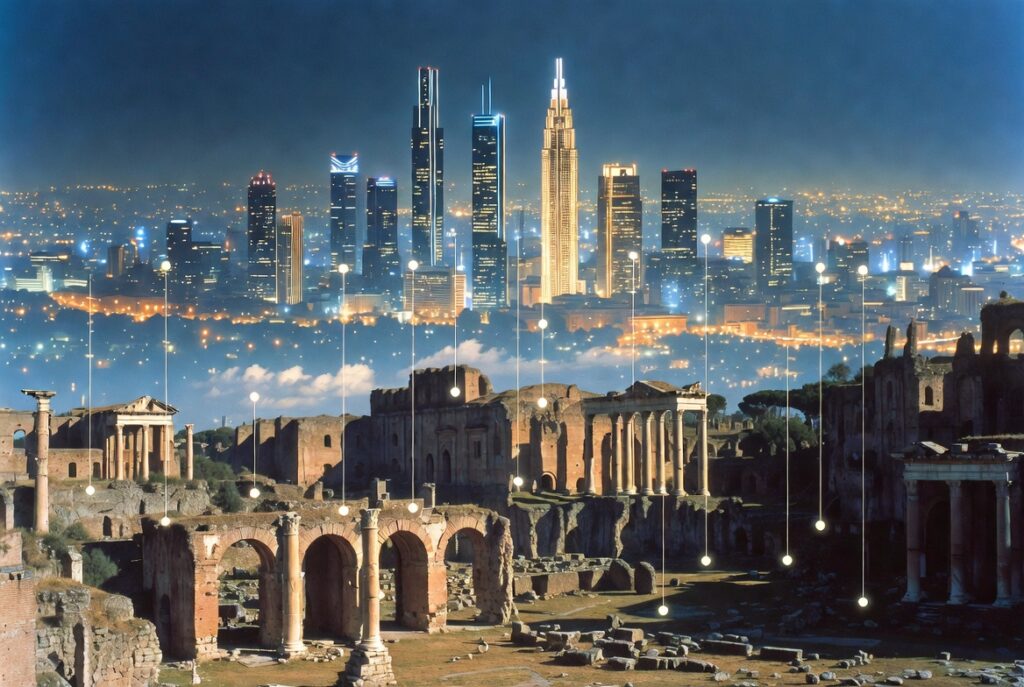
More than 1,500 years later, the story of Rome continues to fascinate historians, policymakers, and ordinary readers alike. Its rise demonstrates the potential of strong institutions and innovation, while its fall reminds us that no civilization is immune to decline.
By studying the Fall of the Roman Empire, we gain valuable insights into the challenges facing societies today and the importance of adaptability, unity, and effective governance for long-term success.
While the Fall of the Roman Empire offers lessons from the ancient world, modern societies continue to face challenges related to leadership, economic stability, and global influence. Read our analysis of Trump’s Second Term and the executive orders reshaping America and the world.