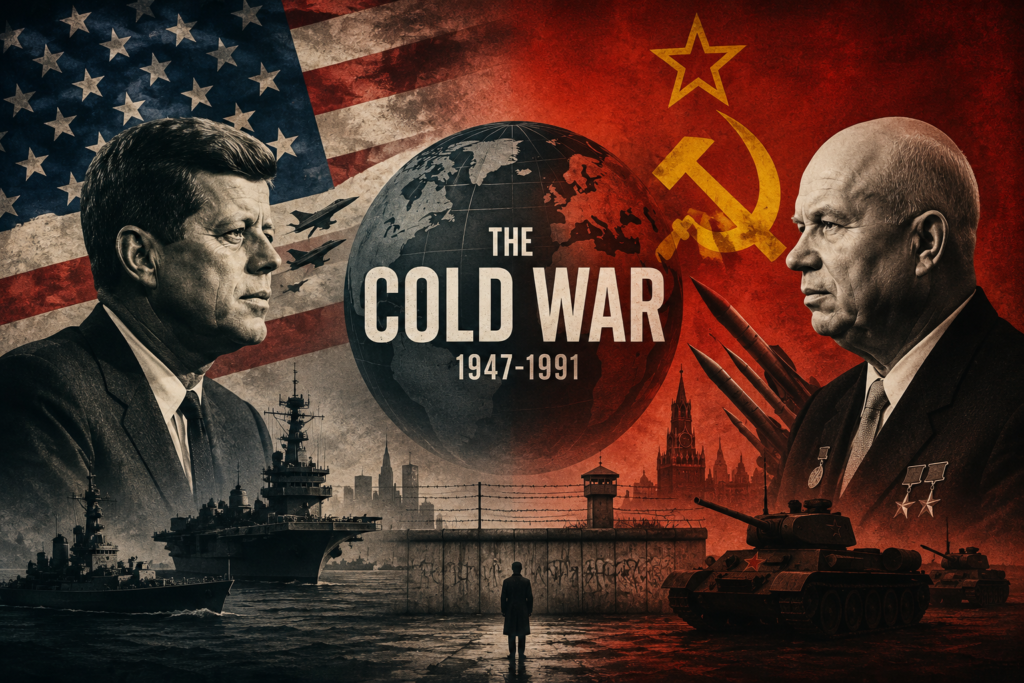
For 46 years, the world lived under the shadow of a war that was never officially fought.
No formal declaration of war was ever signed. No army from the United States ever fired directly on a Soviet soldier in open battle. And yet the Cold War shaped global politics more profoundly than almost any conventional conflict in history — dividing nations, fueling proxy wars on multiple continents, and bringing humanity closer to nuclear annihilation than at any other point in its existence.
From 1945 to 1991, two superpowers — the United States and the Soviet Union — waged a struggle for global dominance fought not with soldiers on a single battlefield, but through espionage, propaganda, economic pressure, and a terrifying arms race. Understanding the Cold War is essential to understanding the modern world, because the institutions, alliances, and tensions it created are still shaping international relations today.
This is the complete story of how it started, how it nearly ended in catastrophe, and how it finally came to a close.
What Was the Cold War?
The term “Cold War” describes a state of political and military tension between the United States and its allies on one side, and the Soviet Union and its allies on the other, lasting from roughly 1945 until the collapse of the Soviet Union in 1991.
It was called “cold” because the two superpowers never engaged in direct, large-scale armed combat with each other. Instead, the conflict was fought through political maneuvering, economic competition, espionage, propaganda campaigns, and proxy wars fought by allied nations in Korea, Vietnam, Afghanistan, and elsewhere.
At its core, the Cold War was an ideological battle. The United States championed capitalism and liberal democracy. The Soviet Union promoted communism and one-party state control. Each side believed its system represented the future of human civilization — and each was determined to prevent the other from spreading its influence across the globe.
How Did the Cold War Start?
The roots of the Cold War can be traced back to 1917, when the Russian Revolution overthrew the Tsar and established a communist government under Vladimir Lenin. This event alarmed Western capitalist nations, which viewed communism as a direct threat to their economic and political systems.
For nearly three decades, that tension remained largely dormant — overshadowed first by the Great Depression and then by the urgent need to defeat Nazi Germany during World War II. The United States, Britain, and the Soviet Union became uneasy allies, united by a common enemy.
That alliance began to fracture almost immediately after victory in Europe in 1945. At the Yalta and Potsdam conferences, the Allied leaders divided Germany and much of Eastern Europe into zones of occupation. The United States and Britain wanted to see democratic governments restored across the continent. The Soviet Union, having suffered catastrophic losses fighting Nazi Germany, was determined to create a buffer zone of friendly, communist-aligned states along its western border to prevent any future invasion.
As Soviet-backed communist governments took power across Eastern Europe in the years that followed, American officials grew increasingly alarmed. By 1947, the wartime alliance had completely dissolved into mutual suspicion and hostility — and the Cold War had effectively begun.
The Iron Curtain and the Division of Europe
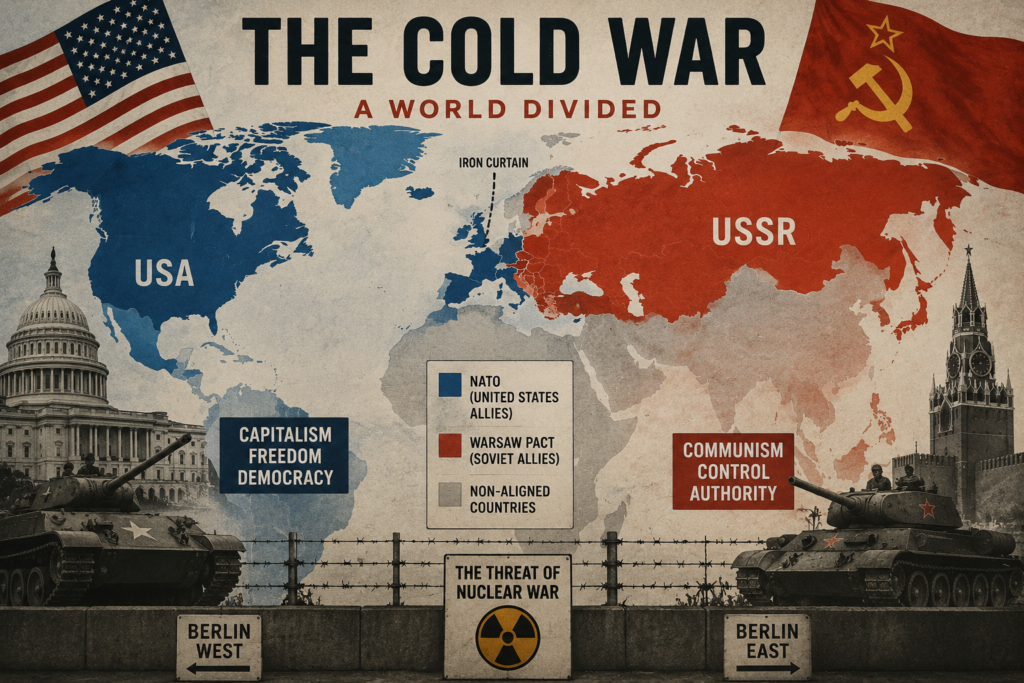
In a 1946 speech, former British Prime Minister Winston Churchill warned that an “iron curtain” had descended across Europe, dividing the continent between the Soviet-controlled East and the democratic West. The phrase captured the new reality perfectly, and it stuck.
Germany itself became the most visible symbol of this division. Following the war, the country was split into four occupation zones controlled by the United States, Britain, France, and the Soviet Union. These eventually consolidated into two separate nations: West Germany, aligned with the United States and Western Europe, and East Germany, a Soviet satellite state under communist rule.
Berlin, though located deep inside East German territory, was itself divided into West Berlin and East Berlin — a divided city within a divided country, that would become one of the most contested flashpoints of the entire Cold War.
The Berlin Blockade and Airlift
The first major crisis of the Cold War erupted in 1948, when the Soviet Union blockaded all road, rail, and canal access to West Berlin, attempting to force the Western Allies out of the city entirely by cutting off food, fuel, and supplies to its two million residents.
Rather than abandon West Berlin or risk a military confrontation, the United States and Britain launched an extraordinary response: the Berlin Airlift. Over the course of 321 days, Allied aircraft flew an astonishing 275,000 flights into the city, delivering up to 4,000 tons of supplies every single day — everything from food and medicine to coal for heating.
The blockade, intended to break Western resolve, instead became a public relations disaster for the Soviet Union. Stalin lifted the blockade in May 1949, having demonstrated nothing except the willingness of the West to defend its position. It was an early signal of how the entire Cold War would be fought: through resolve, propaganda, and calculated risk rather than direct military confrontation.
NATO, the Warsaw Pact, and the Nuclear Arms Race
As tensions deepened, both sides formalized their alliances. In 1949, the United States and its Western allies created NATO — the North Atlantic Treaty Organization — a military alliance committing its members to mutual defense against Soviet aggression. In response, the Soviet Union and its Eastern European satellite states formed the Warsaw Pact in 1955.
Perhaps the most terrifying dimension of the Cold War was the nuclear arms race. The United States had been the sole possessor of atomic weapons since 1945, having used them against Hiroshima and Nagasaki to end World War II. That monopoly ended in 1949, when the Soviet Union successfully tested its own atomic bomb.
What followed was a decades-long competition to build bigger, more powerful, and more numerous nuclear weapons. By the height of the Cold War, the United States and the Soviet Union together possessed tens of thousands of nuclear warheads — enough destructive power to end human civilization many times over. This terrifying balance gave rise to the doctrine known as “mutually assured destruction”: the idea that neither side would launch a nuclear first strike because the certain retaliation would destroy both nations completely.
The Cuban Missile Crisis: 13 Days on the Brink
No single event brought the world closer to nuclear war than the Cuban Missile Crisis of October 1962.
When American intelligence discovered that the Soviet Union was secretly installing nuclear-armed missiles in Cuba — just 90 miles from the coast of Florida — President John F. Kennedy faced an agonizing decision. The missiles, once operational, would be capable of striking most major American cities with only minutes of warning.
For 13 days, the world held its breath as the United States imposed a naval blockade around Cuba, and tense, secret negotiations took place between Washington and Moscow. American military forces were placed on their highest alert level ever reached. A single miscalculation, a single accidental incident, could have triggered a nuclear exchange that would have killed hundreds of millions of people.
The crisis was ultimately resolved through diplomacy: the Soviet Union agreed to remove its missiles from Cuba in exchange for a public American pledge never to invade the island, along with a secret agreement to remove American missiles from Turkey. The world had come closer to nuclear war than at any other point in history — and both superpowers emerged from the crisis determined to prevent it from happening again.
Proxy Wars: Korea, Vietnam, and Beyond
While the United States and the Soviet Union never fought each other directly, they fought each other constantly through proxy conflicts — wars in which each superpower backed opposing sides in regional conflicts around the world.
The Korean War (1950–1953) saw American-led United Nations forces fighting to defend South Korea against a North Korean invasion backed by the Soviet Union and China. The war ended in a stalemate, with the Korean peninsula remaining divided along almost the exact same border to this day.
The Vietnam War became the most divisive and costly proxy conflict of the Cold War for the United States. American forces fought for over a decade to prevent the spread of communism into South Vietnam, ultimately withdrawing in 1973 after enormous human and political cost. The war deeply scarred American society and severely damaged confidence in U.S. foreign policy.
Beyond Korea and Vietnam, the Cold War played out through conflicts and interventions across Africa, Latin America, and the Middle East — including the Soviet invasion of Afghanistan in 1979, which became, in many respects, the Soviet Union’s own Vietnam, draining its resources and morale for nearly a decade.
For a detailed historical overview of the Cold War, readers can explore Encyclopaedia Britannica’s comprehensive analysis of the conflict.
The Space Race: Competition Beyond Earth
The Cold War extended even beyond the planet itself. The Space Race became one of the most visible and inspiring forms of superpower competition, as both nations sought to demonstrate the superiority of their technology and political system through achievements in space exploration.
The Soviet Union stunned the world in 1957 by launching Sputnik, the first artificial satellite to orbit the Earth — a moment that shocked American confidence and triggered a massive increase in U.S. investment in science and technology education. The Soviets extended their lead in 1961 when Yuri Gagarin became the first human to travel into space.
The United States ultimately won the most symbolically significant chapter of the Space Race in 1969, when Apollo 11 landed the first humans on the Moon. It was, in many ways, the Cold War’s most peaceful and constructive legacy — a competition that pushed the boundaries of human achievement even as it was rooted in geopolitical rivalry.
How Did the Cold War End?
The Cold War did not end suddenly. It unraveled gradually over more than a decade, driven by economic strain, political reform, and shifting global dynamics.
By the 1970s and 1980s, the Soviet economy was struggling under the weight of massive military spending, inefficient central planning, and the costly war in Afghanistan. When Mikhail Gorbachev became the Soviet leader in 1985, he introduced sweeping reforms known as glasnost (openness) and perestroika (restructuring), intended to revitalize the stagnant Soviet system.
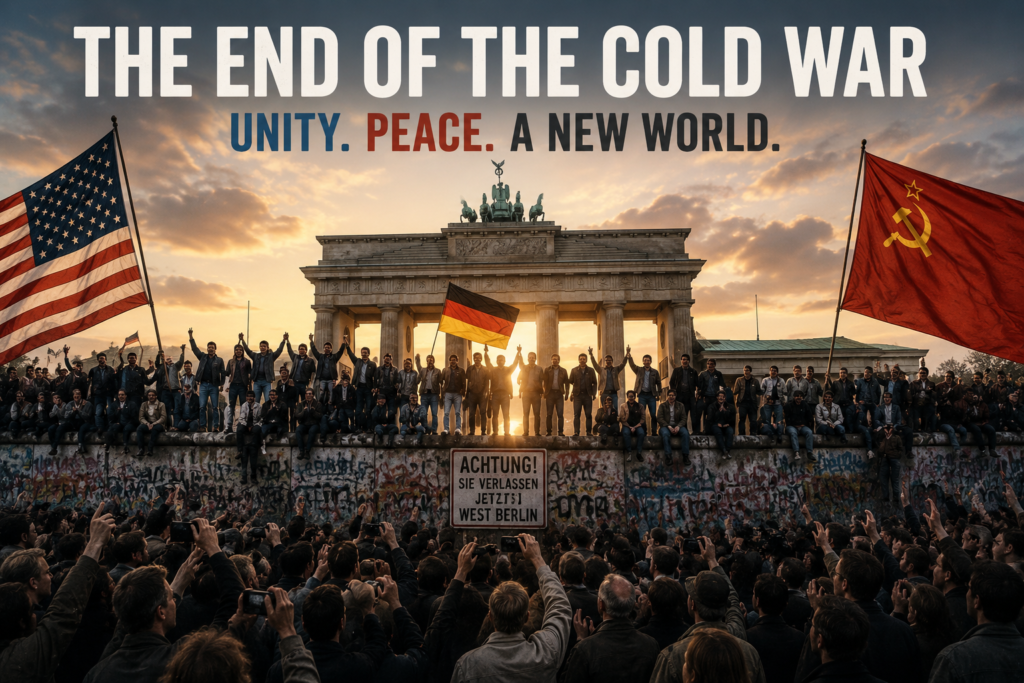
Instead, these reforms accelerated the system’s collapse. Loosened censorship allowed long-suppressed criticism of the government to surface. Eastern European nations, sensing weakening Soviet control, began asserting their independence. In November 1989, the Berlin Wall — the most enduring physical symbol of the Cold War’s division — was torn down by jubilant crowds, an event broadcast to a stunned world.
Two years later, in December 1991, the Soviet Union officially dissolved into 15 independent states. Boris Yeltsin became the president of the newly independent Russian Federation. After 46 years, the Cold War was finally over — not with a nuclear exchange, but with the quiet collapse of one side’s political and economic system.
Why the Cold War Still Matters Today
More than three decades after its end, the Cold War’s legacy continues to shape global politics in ways that are impossible to ignore.
NATO, created specifically to counter Soviet expansion, remains one of the most powerful military alliances in the world — and its continued existence and expansion remains a central point of tension in relations between Russia and the West. The divided Korean peninsula, a direct legacy of Cold War-era proxy conflict, remains one of the most heavily militarized borders on Earth. Nuclear weapons, developed and stockpiled during the Cold War arms race, remain a defining feature of international security calculations.
Perhaps most importantly, the ideological and strategic patterns established during the Cold War — competition between major powers for global influence, the use of proxy conflicts to avoid direct confrontation, and the role of alliances in containing rival powers — continue to inform how nations like the United States, Russia, and China approach international relations today.
Conclusion: The War That Shaped the Modern World
The Cold War was unlike any conflict that came before it. It was fought without major direct battles between its two principal combatants, yet it claimed millions of lives through proxy wars, shaped the political map of dozens of nations, and came within minutes of ending human civilization during the Cuban Missile Crisis.
Understanding the Cold War is not simply an exercise in history. It is essential context for understanding why the world is organized the way it is today — why certain alliances exist, why certain borders remain divided, and why the balance of nuclear power continues to define global security.
The Cold War ended in 1991. Its consequences never did.
The Cold War emerged directly from the aftermath of World War II. To understand how the alliance between the United States and the Soviet Union transformed into a global rivalry, read our complete guide to World War II.