
The 2026 FIFA World Cup has officially kicked off — and it is already breaking records before half the group stage is even over. Hosted across three countries, featuring the largest field in tournament history, and drawing the kind of global attention that dwarfs every previous edition, this is not just another World Cup. It is a once-in-a-generation sporting event.
But beyond the goals and the headlines, there are facts about this tournament that most fans — even passionate ones — simply do not know. Numbers that shock. Stories that astonish. Details that make you realize just how extraordinary the 2026 World Cup truly is.
Here are 10 surprising facts about the FIFA World Cup 2026 that will change the way you watch the tournament.
Fact #1: More People Requested Tickets Than Almost the Entire Population of North America
When FIFA opened its ticket application window for the 2026 World Cup, the response was unlike anything in sporting history. FIFA confirmed it had received more than 500 million ticket requests during a single 33-day application window — a figure described internally as unprecedented.
To put that in perspective: the entire population of North America is around 600 million people. Half a billion ticket requests for a tournament with roughly 6 million tickets available. That is a demand-to-supply ratio that no sport, no concert, and no event in human history has ever come close to matching.
FIFA President Gianni Infantino stated that as of June 10, over 6 million tickets had already been sold — calling it “unprecedented, not by a little bit, but unprecedented by a factor of 10 or more.”
Fact #2: For the First Time Ever, Three Countries Are Hosting the World Cup Simultaneously
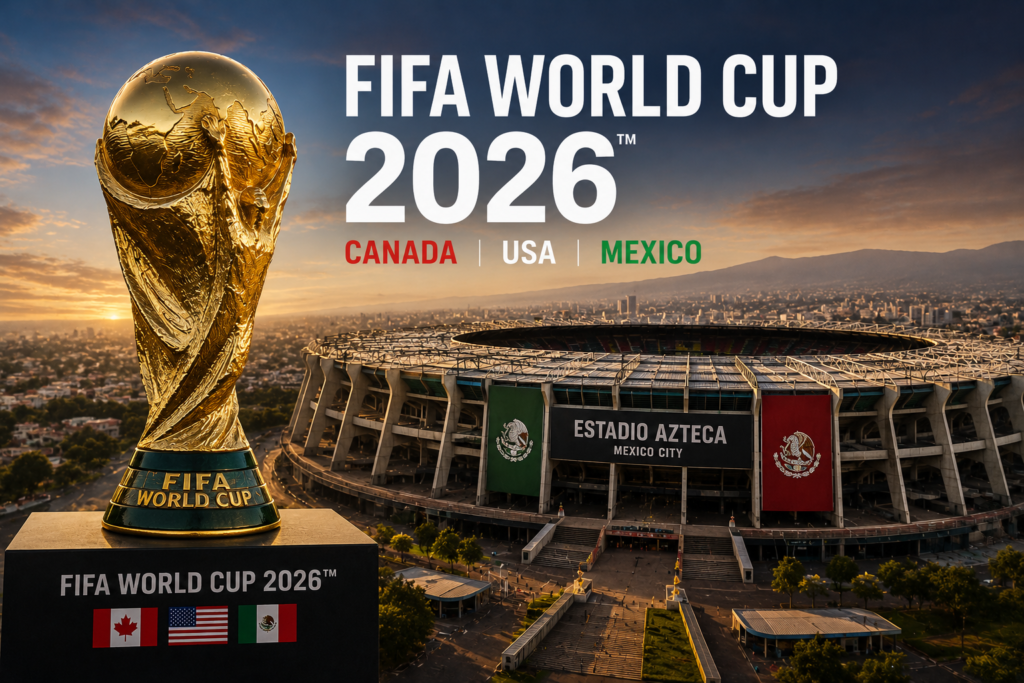
Never before in the history of the tournament has a men’s World Cup been split between three host nations. The United States, Mexico, and Canada are sharing hosting duties across 16 cities — from Vancouver in the north to Mexico City in the south, with Miami, Los Angeles, New York, and Dallas in between.
The United States is staging the majority of matches, including all knockout ties from the quarter-finals onwards. The final will be held on July 19 at MetLife Stadium in New Jersey — temporarily rebranded as the New York/New Jersey Stadium for the occasion.
This three-country format required years of logistical planning, cross-border cooperation, and coordination between three FIFA confederations. It is a model that may define how mega-events are organized for decades to come.
Fact #3: The Total Prize Money Is $727 Million — a 50% Jump From 2022
The financial scale of the 2026 World Cup is staggering. FIFA announced a record prize fund of $727 million for the tournament — an increase of approximately 50 percent compared to the $440 million distributed at the 2022 World Cup in Qatar.
The winning nation will take home $50 million — the largest champions’ payout in World Cup history. Even the teams that are eliminated in the group stage will receive at least $10.5 million each, ensuring that all 48 participating nations leave North America with a significant financial return.
For comparison: when Argentina won the 2022 World Cup, they received $42 million. The 2026 champions will earn $50 million — before any bonuses, sponsorship deals, or commercial agreements.
Fact #4: The Estadio Azteca Is the First Stadium to Host Three Different World Cups
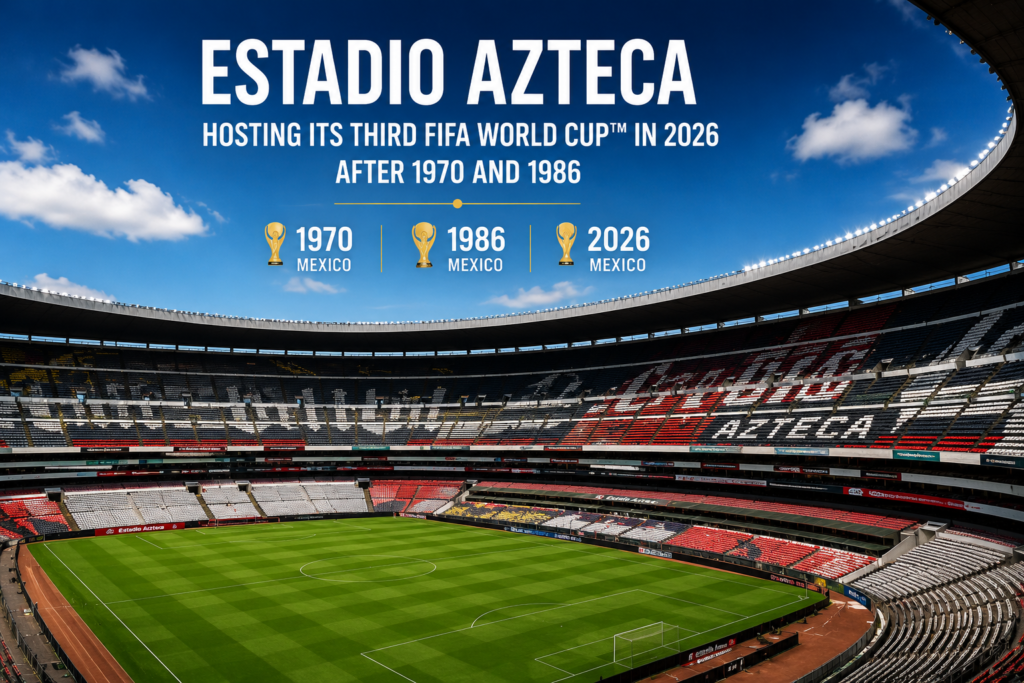
The iconic Estadio Azteca in Mexico City made history on June 11, 2026, when it hosted the tournament’s opening match between Mexico and South Africa. It became the first venue in history to host matches at three separate FIFA World Cups — having previously welcomed the 1970 and 1986 editions.
In 1970, Brazil’s legendary team — led by Pelé — won the Jules Rimet Trophy in that stadium. In 1986, Diego Maradona scored both the infamous “Hand of God” goal and the universally acclaimed “Goal of the Century” against England on that same pitch. In 2026, a new generation is writing its chapter in the same place.
No other venue on earth can make that claim. The Azteca is not just a football stadium — it is the cathedral of the world’s most popular sport.
Fact #5: This Is the Biggest World Cup Field in History — 48 Teams, 104 Matches
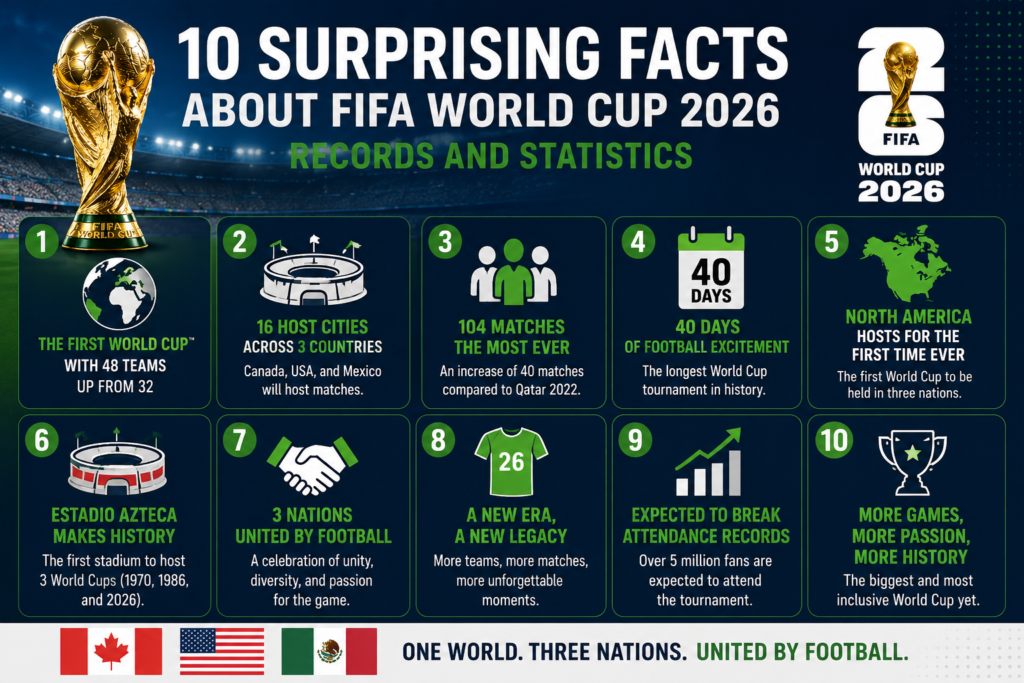
The 2026 World Cup features 48 national teams, up from the 32 that competed in Qatar in 2022. That expansion increased the total number of matches from 64 to 104, spread across 39 days of competition — the longest World Cup ever played.
The format change also opened the door to nations that had never before qualified. Among the debutants at 2026 is Curaçao — officially the smallest nation by population ever to qualify for a men’s World Cup. Their journey to North America represents one of the most remarkable qualification stories in recent football history.
The expanded field also means more representation from Africa, Asia, and the CONCACAF region — making this the most globally diverse World Cup in the tournament’s 96-year history.
Fact #6: Brazil Is the Only Country to Play in Every Single World Cup Since 1930
Since the first FIFA World Cup was held in Uruguay in 1930, only one nation has qualified for every single edition of the tournament: Brazil. Across 96 years and 23 World Cups, Brazil has never missed a tournament — a record of consistency that no other footballing nation has come close to matching.
The five-time champions won the trophy in 1958, 1962, 1970, 1994, and 2002, making them the most successful team in World Cup history by title count. Germany and Italy follow with four titles each — though Italy failed to qualify for 2026, extending their absence to three consecutive tournaments. For a nation that has won four World Cups to miss three in a row is one of the most shocking stories in modern football.
Fact #7: Cristiano Ronaldo Has More Social Media Followers Than the Entire Population of Europe
Among all the players competing at the 2026 World Cup, Cristiano Ronaldo leads every social media ranking by an extraordinary margin. The Portuguese captain has 665.6 million followers across his platforms — more than the population of Europe, which stands at approximately 750 million.
Lionel Messi follows with 506.5 million followers, placing both players in a category entirely their own — far ahead of every other athlete on the planet.
Both Ronaldo and Messi are widely expected to be playing in their final World Cup. The emotional weight of watching two of the greatest footballers in history potentially competing for the last time on the game’s biggest stage gives the 2026 tournament a significance that goes far beyond sport.
Fact #8: A Record 1,248 Players Are Competing — and 891 Have Never Played in a World Cup Before
With 48 teams and 26-man squads, the 2026 World Cup features a record 1,248 players. Of those, 891 are making their World Cup debut — meaning that nearly three out of every four players at this tournament have never experienced anything like it before.
At the other extreme, Scotland’s goalkeeper Craig Gordon is competing at his first-ever World Cup at the age of 43 — making him the oldest player at the tournament and the second oldest in World Cup history. As of the opening week, seven players over the age of 40 are competing across different squads.
The range of experience on display — from teenagers making their debut to veterans in their 40s chasing a lifelong dream — is unlike anything the game has seen before.
Fact #9: An Estimated 6 Billion People Will Watch — Potentially the Most-Viewed Event in Human History
FIFA projects that approximately six billion people will engage with the 2026 World Cup in some form — through live broadcasts, streaming platforms, highlight clips, or social media. The global population is approximately 8 billion, meaning FIFA expects three out of every four people alive on earth to follow the tournament in some way.
Even allowing for optimism in FIFA’s projections, the scale of global viewership is extraordinary. No film, no television series, no political event, and no other sporting competition comes close to generating the simultaneous worldwide attention of a World Cup final.
The tournament is also expected to generate over $13 billion in total revenue for FIFA — making it the most financially significant sporting event on the planet by a considerable margin.
Fact #10: The Real World Cup Trophy Can Only Be Touched by Three Categories of People
The FIFA World Cup trophy is one of the most recognizable objects in the world — but almost nobody is actually allowed to touch it.
Introduced in 1974, the current trophy is made of 18-karat solid gold, weighs 6.175 kilograms, and stands 36.8 centimeters tall. According to FIFA’s strict protocol, only three categories of people are permitted to handle the real trophy: the FIFA President, recognized heads of state, and the winning team captain — and even then, usually while wearing white gloves.
The trophy that winning players lift above their heads on the pitch and parade around the stadium is actually a gold-plated replica. The original stays locked in a climate-controlled vault. In the entire history of the tournament, only a very small number of people have ever held the real thing.
It is a fitting symbol for the World Cup itself: something billions of people follow with passion and devotion, but which only the rarest few ever truly get to hold.
Conclusion: The 2026 World Cup Is a Moment Unlike Any Other
The numbers behind the 2026 FIFA World Cup are not just statistics — they are a reflection of how deeply football is woven into the fabric of human life around the world. Half a billion ticket requests. Six billion projected viewers. A $727 million prize fund. A stadium hosting its third World Cup. Two legends playing their final tournament.
Every fact on this list points to the same conclusion: the 2026 World Cup is not just the biggest sporting event happening right now. By almost every measurable standard, it is the biggest sporting event in human history.
And it has only just begun.
Enjoyed this article? Find more in-depth stories about the world’s biggest events, people, and history at Info Is The Key — your source for clear, well-researched, and reliable content about the world.
Sources: FIFA, Al Jazeera, NPR, Euronews, Sporting Tribune, IBTimes UK, PolitiFact, Sports Illustrated Tags: FIFA World Cup 2026, World Cup facts, soccer facts, football trivia, World Cup records, 2026 tournament Category: Curiosity