Cost to Start an Online Business vs. a Physical One: The Real Numbers
Two figures get quoted constantly whenever anyone asks about the cost to start an online business, and both are misleading on their own.
The first is that opening a small physical business runs around $30,000 to $40,000 in the first year. The second is that you can start online for free. The first is roughly right but describes something specific. The second is simply false, and it’s the more damaging of the two, because it sets people up to quit the moment they discover what the real price is.
The honest version is more interesting. Starting online is genuinely cheap — a few hundred dollars covers it — and that difference is real, not marketing. But the money a physical business spends is buying something concrete that an online business has to obtain another way, and obtaining it is where the actual cost sits.
This article lays out both sides using federal data rather than estimates, and then explains the part almost nobody states plainly: what online business charges you instead of money.

Why the Usual Comparison Is Wrong
The $30,000–$40,000 figure isn’t invented. It reflects what a small business with a physical location typically needs in its first year.
The U.S. Small Business Administration’s guidance on calculating startup costs divides new businesses into three categories — brick-and-mortar, online, and service-based — and it does so precisely because their cost structures aren’t comparable. A shop needs a lease, a deposit, fit-out, fixtures, inventory, insurance, licences, utilities, signage, and often staff before a single customer walks in. An online or service business needs almost none of that.
So quoting the brick-and-mortar figure as “the cost of starting a business” describes one of three categories and calls it all of them.
The error runs in the other direction too. “Start for free” usually means the platforms have free tiers, which is true, and then quietly omits everything else.
What a Physical Business Is Actually Buying
Here is the part of the comparison that matters most, and it took me a while to see it properly.
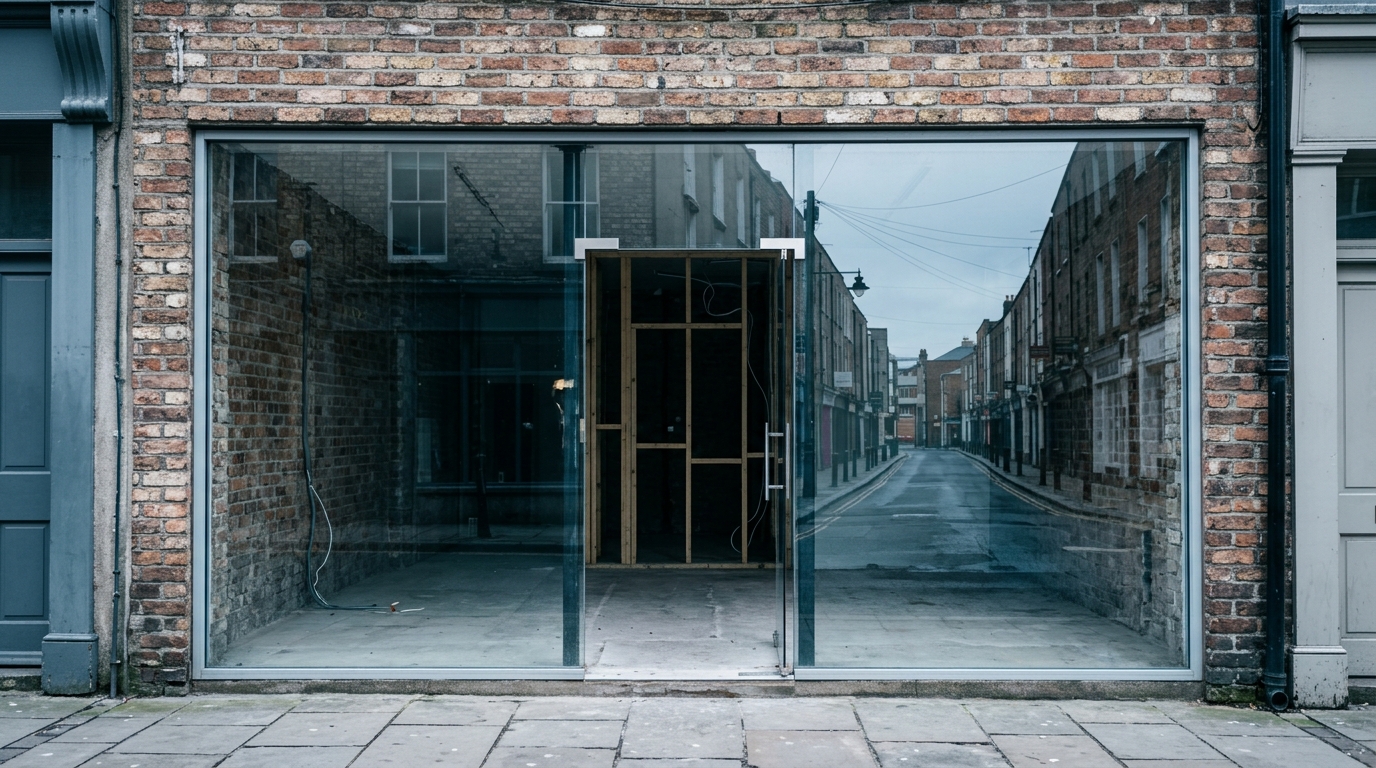
When a shop pays rent for a good location, it is not only buying square metres. It is buying foot traffic — a flow of people who pass the door without anyone having to attract them. A bakery on a busy street has customers on day one. Not many, perhaps, but not zero. The rent purchased attention.
That is an enormous, invisible asset, and it is precisely what an online business does not get.
A new website, channel, or page opens to nobody. Not a slow trickle — literally nobody. There is no street, no passers-by, no one who stumbles in. Every single visitor has to be earned through search, recommendation, or something you made that someone chose to share.
This is the real trade in the comparison. The physical business pays cash up front for attention. The online business pays for it over months, in work.
Both are paying. Only one of them writes a cheque.
The Real Cost to Start an Online Business
With that framing in place, here is what the money side actually looks like for a first online venture:
| Item | Realistic cost | Can you skip it? |
|---|---|---|
| Domain name (1 year) | $12–$15 | No — a free subdomain can’t be sold or moved |
| Hosting (12 months prepaid) | $60–$110 | No, for a site; yes for a channel or page |
| One AI or productivity subscription | $20–$25/month | Not strictly, but it is the highest-leverage cost |
| Professional email | $0–$7/month | Often included with hosting |
| Design tool | $0–$120/year | Yes — free tiers are genuinely sufficient at first |
| Checkout or landing page tool | $0–$30/month | Yes, until you have something to sell |
| Reserve for the unexpected | $100–$150 | No — this is the line people delete and regret |
A realistic first-year total, run lean, lands somewhere between $400 and $900 depending on how many months you keep the subscriptions. Call it a few hundred dollars against tens of thousands. The gap is real and it is the strongest argument for starting online.
It is also worth knowing where that money typically comes from. Across U.S. businesses generally, 74.7% are started with the founder’s personal savings and only 19% involve a bank loan — a pattern I looked at in more detail in where startup capital actually comes from. Nobody is funding this for you, and at these amounts nobody needs to. If the few hundred dollars is the obstacle, saving it deliberately over one focused month is a more realistic plan than waiting for it to appear.

The Second Currency
If money is the first cost and it’s low, the second cost is time — and this is where honesty matters most, because it’s the one that makes people quit.
| What it costs | Physical business | Online business |
|---|---|---|
| Money up front | $30,000–$40,000 typical | $400–$900 |
| Attention on day one | Included in the rent | Zero |
| Time before first customer | Days | Weeks to months |
| Time before meaningful income | Months | 6–18 months, commonly |
| Ongoing fixed costs | High, every month | Very low |
| Cost of failing | Lease, debt, inventory | The money you chose to spend |
Look at rows two and four together. The physical business front-loads money and gets attention immediately. The online business front-loads almost nothing and gets attention slowly, through accumulated work.
Neither is easier. They are difficult in different currencies, and people tend to underestimate whichever currency they have less of.
What this means practically: if you are starting online, the resource you must budget carefully is not dollars — it’s consistent hours over a long enough period. Ten focused hours a week for nine months is a realistic input. Three intense weeks followed by silence is not, and it’s the most common pattern among people who conclude that online business doesn’t work.
The consistency isn’t a motivational slogan here. It’s the mechanism by which attention accumulates, and there is no substitute for it in the online column, the same way there’s no substitute for rent in the physical one.
Both Fail at Similar Rates. The Difference Is What Failure Costs
A detail worth knowing before you choose either path.
The SBA’s 2026 small business figures put average survival across cohorts from 1994 to 2022 at 67.7% after two years, 49.2% after five, and 33.9% after ten. Roughly half of all businesses don’t reach year five.
Note in passing that this also kills the widely repeated claim that 90% fail in year one. Two-thirds are still trading at year two.
But apply that 50% to both columns. If a physical business closes in year three, the owner may be left with a lease to settle, unsold inventory, and debt. If an online business closes in year three, the owner is out a few hundred dollars and a lot of hours — and holds a skill set that transfers directly to the next attempt.
That asymmetry, not the startup cost, is the strongest practical argument for starting online. Not because it’s more likely to succeed, but because the version of failure is survivable.
Where This Comparison Misleads
Four honest limits, because a comparison this clean usually has them.
Online has no customers walking past, ever. I’ve said it twice because it’s the thing people discover too late. A shop with a mediocre product on a good street outperforms a brilliant website nobody has found.
Ongoing costs diverge from startup costs. The online business has almost no fixed monthly costs, which is a genuine long-term advantage the startup comparison understates.
The figures are U.S. national data. Commercial rents, licensing, and business costs vary enormously by country and city. Use the structural pattern, not the exact numbers.
Some businesses simply cannot be online. A restaurant, a barber, a clinic. If what you want to make requires physical presence, this comparison isn’t a choice you get to make.
Which One Fits Your Situation
Physical makes sense if you have capital you can afford to lose, your product genuinely requires a location, you want customers from week one, and you’re prepared for fixed costs that continue whether or not you sell anything.
Online makes sense if capital is the binding constraint, you can commit consistent hours over months without external pressure, you can tolerate a long stretch with no visible result, and you’d rather risk time than debt.
The second list is worth reading carefully, because the hard requirement in it is not money. It’s the ability to keep working on something that isn’t paying yet — which is considerably harder without a boss, deadlines, or anyone noticing than most people expect before they try it.

If You’re Starting Online, Start Here
Four things, in order, and the order matters.
Pick the version that needs the least money. A service business — writing, design, bookkeeping, video editing, virtual assistance — needs a way to be found and a way to be paid, and nothing else. It also produces a first payment faster than any other model, usually in weeks rather than months. The specific categories of work people are currently paying solo operators for are a reasonable place to look for a match.
Buy the domain and hosting first if you’re building a site. Committing real money to a name creates useful pressure, and it’s the one purchase without a worthwhile free alternative.
Publish something within the first week. It will be worse than you want. Publish anyway. Nothing becomes real until a stranger can find it.
Treat the skill as the asset. Money buys tools; a marketable skill is what actually converts effort into income, and unlike the $400, it appreciates while you use it and survives the business failing.
Frequently Asked Questions
How much does it really cost to start an online business? Between roughly $400 and $900 for a realistic first year — domain, hosting, one subscription, and a small reserve. Claims of “completely free” ignore the domain and hosting; claims of thousands usually describe a physical business.
Is it cheaper than opening a physical store? Dramatically, in money. The SBA separates the categories because the cost structures aren’t comparable. In time and consistency it is not cheaper, and that’s the cost people underestimate.
How long before an online business makes money? A service business commonly produces a first payment in one to four weeks. A content site, channel, or audience-based business typically takes six to eighteen months to reach meaningful income. Anyone guaranteeing faster is describing a scam.
Do most new businesses fail? Not in the first year. Roughly 68% survive two years and 49% survive five, per SBA figures. The often-repeated 90% failure claim is not supported by federal data.
Can I really start with no money at all? You can start a service business with essentially nothing — a laptop, an internet connection, and a skill. You cannot build a site you own without a domain and hosting, which is where the minimum few hundred dollars comes from.
What’s the biggest hidden cost? Time before any result appears, and the discipline that requires. It doesn’t show up on any budget, and it’s what most people run out of before the money.
Should I quit my job to do this? No. Building alongside existing income removes the financial pressure that pushes people into rushed decisions, and the timelines above assume part-time effort anyway.
Is online business still worth starting, or is it too late? Solo businesses are now 78.4% of U.S. establishments and their share has grown every year for over a decade, though revenue per business varies enormously by sector. The market is more competitive than it was, and the cost of entry is lower than it has ever been. Both are true at once.
Conclusion
The cost comparison is real, and it favours online by a wide margin. A few hundred dollars against tens of thousands is not a rounding difference, and the version of failure it produces is one you can recover from in a month rather than years.
What the comparison hides is that rent buys something. It buys people walking past the door. An online business gets that for free in money and expensive in time, and the bill arrives as months of work with nothing visible happening.
If you have capital and want customers immediately, physical makes sense. If capital is what you don’t have, and consistency is something you can actually sustain without anyone checking on you, online is not the lesser option. It’s the one where the entry price is low enough to be worth finding out.
A Note from Lucas
I used to read the “start for free” version of this and feel vaguely cheated when it turned out not to be free. What reframed it for me was thinking about what rent actually purchases — I’d never considered that a shop’s biggest hidden asset is simply people walking past, and that I was going to have to build the equivalent by hand, one visitor at a time. That’s the honest trade, and I’d rather someone hear it before they start than discover it in month three. If I could pass on one thing from putting this together: budget the hours as seriously as you’d budget the money, because the hours are the part that actually runs out.
About the Author
Lucas Palma is the founder and editor of Info Is The Key. He writes about online business, entrepreneurship, and the practical mechanics of building income independently, working from primary sources and official data rather than recycled advice.
Last Updated: September 2026 | Reading Time: 9 minutes
Editorial note: This article is educational and does not constitute financial, business, tax, or legal advice. Figures cited are U.S. national data and vary considerably by country, city, and sector. Consult a qualified professional before making significant financial commitments.
Sources
- U.S. Small Business Administration — Calculate Your Startup Costs
- SBA Office of Advocacy — Frequently Asked Questions About Small Business, 2026
- SBA Office of Advocacy — Small Business Finance FAQ (Annual Business Survey data)
- U.S. Census Bureau — Small Business Week: nonemployer establishments
- U.S. Small Business Administration — Write Your Business Plan
Ready to go further? We’re building a course right here on the site that walks through exactly how this blog was built and monetized, step by step — from the first article to the first revenue. Keep an eye on future posts; we’ll share it as soon as it’s ready.