

How to Save $500 in 30 Days and Turn It Into Your First Business
There is a specific kind of frustration that comes from wanting to start a business and having nothing to start it with. You read about founders who raised money, or who had a spare $10,000 sitting around, and the whole idea starts to feel like something reserved for people who were already comfortable. So the plan gets postponed to a vague someday, and someday never has a date on it.
Here is what almost nobody tells you: the amount of money required to start a real, revenue-generating business in 2026 is dramatically lower than it was even ten years ago — and a lot lower than most people assume. Not zero. Anyone promising zero is selling you something. But low enough that the number you need is closer to one month of focused saving than one year of it.
This guide is about how to save $500 in 30 days and then deploy it — not into a savings account, but into the specific infrastructure a one-person online business actually runs on. The saving half and the spending half are one plan. Treating them separately is how most people end up with $500 in an account and no business.

Why $500 Is the Real Starting Number
The U.S. Small Business Administration, in its guidance on calculating startup costs, splits new businesses into three categories with wildly different cost floors: brick-and-mortar operations, online businesses, and service-based businesses. That split is the whole point. The often-quoted figures of $30,000 to $40,000 for a first year of operation come overwhelmingly from the first category — a business with a lease, inventory, fixtures, insurance, and staff.
An online or service business carries almost none of that. No lease. No inventory. No storefront. What remains is a domain name, hosting, one or two software subscriptions, and your own time. That is a fundamentally different financial problem, and it is the one this article solves.
The scale of this shift is not anecdotal. Census Bureau data shows that 78.4% of U.S. business establishments have no employees at all — they are single-operator businesses. Nonemployer firms are not a fringe category. They are the statistical majority of American businesses, and the great majority of them were started with small amounts of personal money rather than outside investment.
$500 is also a psychologically honest number. It is large enough that saving it requires you to actually change something for a month, which means the act of saving it functions as a test of whether you will do the harder work that follows. And it is small enough that you can lose it entirely and recover. Both of those properties matter more than the dollar figure itself.
What $500 Actually Buys in 2026
Before saving anything, it helps to see precisely where the money goes. Vagueness is what kills this plan — “I’ll save up and figure it out” produces neither the savings nor the business. Here is a realistic allocation for a first online venture:
| Item | Cost | Why it earns a place |
|---|---|---|
| Domain name (1 year) | $12–$15 | Your own asset. Non-negotiable — a free subdomain cannot be sold, moved, or built on. |
| Web hosting (12 months, prepaid) | $60–$110 | Prepaying annually is the single biggest discount available to a new business. |
| One AI subscription | $20–$25/mo | Drafting, research, code, design. The highest-leverage recurring cost on this list. |
| Professional email | $0–$7/mo | Free with most hosting. A branded address measurably raises reply rates on cold outreach. |
| Design tool (annual) | $0–$120 | The free tier genuinely suffices for months. Upgrade from revenue, not from savings. |
| Landing page or checkout tool | $0–$30/mo | Free tiers exist for all of these. Skip until you have something to sell. |
| Unallocated reserve | $100–$150 | The line most people delete. Keep it. |
Two things about that table deserve emphasis.
First, the reserve. Every first-time founder underestimates the number of small, unforeseeable costs that appear in month one — a plugin, a stock photo license, a payment-processing fee, a renewal you forgot. A reserve is what separates a business that absorbs those from one that stalls out over $40.
Second, notice how many lines say $0. Most of the tools a first business needs have functional free tiers. The discipline here is refusing to pay for anything before it is generating or directly enabling revenue. Paid tools bought in advance of customers are the most common way a first $500 disappears without producing anything.
The 30-Day Plan to Get There
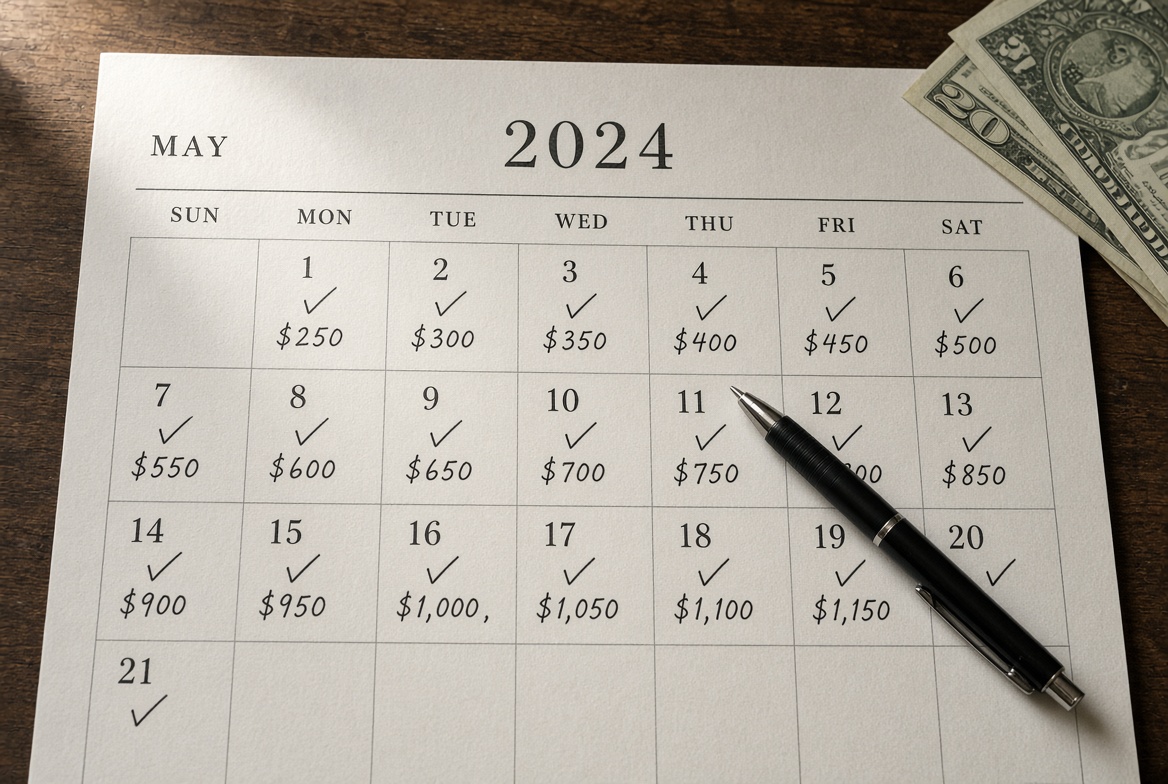
$500 in 30 days works out to roughly $17 a day, or $125 a week. Seen as a lump sum it is intimidating. Seen as $17 it is a restaurant meal you did not buy. Breaking it into weekly checkpoints makes progress measurable and, more importantly, makes a bad week recoverable.
| Week | Target | Running total | Primary lever |
|---|---|---|---|
| 1 | $125 | $125 | Audit spending and cancel unused subscriptions |
| 2 | $125 | $250 | Sell five to ten unused items |
| 3 | $125 | $375 | Cut one spending category in half |
| 4 | $125 | $500 | One-off freelance or gig work |
The four levers are sequenced deliberately, easiest first. Week one is pure subtraction and takes an afternoon: go through your bank statement line by line and cancel anything you have not used in the past month. For most households this alone recovers $20 to $60 a month, and it requires no ongoing willpower once done.
Week two is the highest-yield week for most people. Unused electronics, clothes, and furniture sitting in a closet are dead capital. Selling five to ten items realistically produces $50 to $150, often within days, and local marketplace apps move small items faster than shipping-based platforms — which matters on a 30-day clock.
Week three is the only week that demands sustained restraint, and it is limited on purpose: pick one category — delivery apps, rideshares, impulse purchases — and cut it roughly in half. Not everything. One. Across-the-board spending freezes collapse within two weeks because they remove too much at once.
Week four is additive rather than subtractive. A single weekend of gig or freelance work covers the final $125, and it doubles as reconnaissance: whatever people will pay you for right now is a strong signal about what your business should sell.
If your income is irregular, ignore the weekly numbers and watch only the running total on day 30. Perfect weekly consistency is not the goal.
Four Businesses You Can Actually Start With $500
This is the part that determines whether the $500 becomes a business or just sits in an account. Each of these fits inside the budget above, and each has a different tradeoff between speed of first revenue and long-term ceiling.
A Content Site
Cost: roughly $150 up front (domain plus a year of prepaid hosting), plus whatever AI subscription you keep. Revenue arrives slowly — search traffic takes months to build, and ad or affiliate income requires real volume. But the asset compounds. Every article published continues working, and a site with traffic can eventually be sold outright.
Best suited to someone with genuine interest in a subject and patience measured in quarters rather than weeks.
A Service Business
Cost: nearly nothing. Writing, design, editing, bookkeeping, video editing, virtual assistance, ad management. You need a way to be found and a way to be paid. This is the fastest path to a first dollar — typically one to four weeks — because you are selling to one identifiable buyer rather than waiting for an audience to accumulate.
The tradeoff is that it does not scale on its own. Your income is capped by your hours until you either raise rates substantially or hire. Many founders start here specifically to fund something else.
A Digital Product
Cost: $0 to $50, mostly for a checkout tool. A template, spreadsheet, guide, preset pack, or course. Built once, sold repeatedly, with no inventory and no shipping. The difficulty is not production — it is distribution. Nobody buys from a stranger, which is why digital products work best layered on top of an audience you already have from a content site, a channel, or a service client base.
A Video or Audio Channel
Cost: effectively $0 if you already own a phone. The slowest to monetize of the four — platform thresholds require real subscriber and watch-time numbers — but the highest ceiling, because attention is the scarcest commodity online and a channel that earns it can be monetized many different ways at once.
| Path | Upfront cost | Typical time to first revenue | Scales without you? |
|---|---|---|---|
| Service business | $0–$50 | 1–4 weeks | No |
| Digital product | $0–$50 | 4–8 weeks | Yes |
| Content site | $100–$200 | 3–9 months | Yes |
| Video/audio channel | $0–$100 | 6–12 months | Yes |
A note on the obvious strategy: start with a service business to generate cash, and use that cash to fund a content site or digital product that scales. This is the most common real-world path among one-person businesses, and it is more reliable than picking the highest-ceiling option first and running out of money before it produces anything.
What Not to Spend the $500 On
The fastest way to lose a first $500 is not a bad business idea. It is buying things that feel like progress but are not.
Courses and paid systems, before you have tried the free version. Almost everything a beginner needs is documented publicly, including by the SBA itself in its guidance on writing a business plan. Buy education to break a specific wall you have already hit — never to avoid starting.
Logos, branding, and business cards. None of these produce a customer. A recognizable brand is something you earn after having customers, not a prerequisite for getting them.
Paid advertising, before you know what converts. Ads amplify an offer that already works. Pointed at an untested offer, they are simply a faster way to spend $200 learning nothing.
Anything sold to you with urgency. The Federal Trade Commission’s guidance on money-making opportunity scamsdescribes a consistent pattern: guaranteed income claims, vague descriptions of the actual work, and payment demanded before you have seen any evidence it works. A legitimate business model never requires you to pay upfront for the privilege of earning. If something pressures you to decide today, that pressure is the product.
Legal and accounting structure, on day one. Most first businesses begin as sole proprietorships by default. Incorporating is worth money once there is revenue and liability to protect — not before.

The Order of Operations After Day 30
Having the money is not the same as having started. A workable first week:
Buy the domain and hosting first. Committing real money to a name creates useful psychological pressure, and it is the one purchase with no free alternative worth taking.
Publish something within seven days — one article, one service page, one video, one product listing. It will be worse than you want. Publish it anyway. Nothing about a business becomes real until something exists in public that a stranger can find.
Talk to ten potential customers in the first two weeks. Direct messages, emails, community posts. Ten conversations teach you more about what people will pay for than a month of planning in isolation.
Do not touch the reserve for at least sixty days. It exists for a genuine unforeseen need, not for the first tool that looks appealing.
And keep one honest ledger from the beginning. Once a side business produces income, it becomes reportable, and reconstructing six months of scattered records is a miserable way to spend a weekend.
Common Mistakes That Derail This Plan
Most people who fail at this fail in one of five identifiable ways:
Saving the $500 and never deploying it. The money feels safer in the account than spent on something uncertain. This is the single most common outcome, and it is why the saving and spending halves belong in the same plan.
Spending it all in week one. Three subscriptions, a premium theme, and a logo, before a single customer exists. Buy the minimum, keep the reserve.
Choosing a business based on income ceiling rather than personal fit. The highest-earning model is irrelevant if you abandon it in month two. Pick what you will still be doing in ninety days.
Switching paths every few weeks. Every model has a delay between effort and result. Switching resets that delay to zero and guarantees you never reach it.
Waiting for more capital. $500 is enough to begin. Waiting for $5,000 usually means waiting indefinitely, and the skills you build spending the first $500 are precisely what make a larger amount useful later.
Frequently Asked Questions
Is $500 really enough to start a business? For an online or service business, yes. The SBA’s own cost framework separates these from brick-and-mortar businesses precisely because the cost structures are not comparable — no lease, no inventory, no fixtures. It is not enough for a physical storefront, and no honest guide will tell you otherwise.
Can I save $500 in 30 days on a low income? It is harder, and it may take forty-five to sixty days rather than thirty. The two levers that do not require disposable income are canceling unused subscriptions and selling things you already own. If both are exhausted and the gap remains, extend the timeline rather than abandoning the plan — the plan works at sixty days too.
Which business should I pick if I want money fastest? A service business, almost without exception. You are selling to one identifiable buyer rather than waiting for an audience or search traffic to build, which compresses time-to-first-payment to weeks rather than months.
Do I need an LLC or registered company before starting? Not for most beginners. Most first businesses operate as sole proprietorships by default. Formal structure matters once there is meaningful revenue and liability to protect. Verify the specifics for your own country and state rather than assuming.
What if I lose the entire $500? Then it cost you $500 and one month to learn something most people pay far more for, or never learn at all. This is the actual argument for starting small: the downside is survivable, and the experience transfers directly to the next attempt. Never fund a first business with money you need for rent.
Should I pay off debt before starting a business? High-interest debt, particularly credit cards, generally deserves priority — its guaranteed cost usually exceeds any realistic first-year business return. For lower-interest debt the calculation is less clear-cut. This is a personal financial decision, not a business one, and it is worth discussing with a qualified advisor if the amounts are significant.
How long until it makes real money? A service business commonly produces its first payment in one to four weeks and meaningful income in two to three months. A content site or channel typically takes six to twelve months to reach any significant revenue. Anyone offering a faster guarantee is describing a scam, not a business.
Should I quit my job to do this? No. Building alongside existing income removes the financial desperation that pushes people into rushed, short-term decisions. Nearly every sustainable one-person business was built in evenings and weekends before it replaced anything.
Conclusion
The barrier to starting a business in 2026 is genuinely not capital. It is the belief that capital is the barrier — a belief that conveniently postpones the uncomfortable work of publishing something, talking to strangers, and being bad at something in public.
$500 buys a domain, a year of hosting, the software you actually need, and a reserve for the unexpected. Thirty days of deliberate saving produces it. The plan above is simply the two halves joined: a month of disciplined subtraction, then a deliberate purchase of infrastructure, then something published within a week.
The saving is the easy half. It has a clear number and a clear deadline. The second half is where most people stop — which is exactly why finishing it puts you in a much smaller group than you would expect.
A Note from Lucas
I wrote this one because I kept seeing the same question phrased two different ways — “how do I save $500” and “how do I start a business with no money” — and nobody was treating them as the same question. They are. What changed my own thinking was reading the SBA’s cost categories closely and realizing how much of the scary $30,000 figure is lease, inventory, and fixtures that an online business simply does not have. If I could give one piece of advice from this whole article, it would be to keep the reserve. I have spent my own reserve early more than once, and every time it turned a small solvable problem into a reason to stop.
About the Author
Lucas Palma is the founder and editor of Info Is The Key. He researches and writes about online business, entrepreneurship, and the practical mechanics of building income independently, working through primary sources and official data rather than recycled advice.
Last Updated: September 2026 | Reading Time: 10 minutes
Editorial note: This article is educational and does not constitute financial, legal, or tax advice. Business costs, regulations, and reporting requirements vary by country and state. Consult a qualified professional before making significant financial decisions.
Sources
- U.S. Small Business Administration — Calculate Your Startup Costs
- U.S. Small Business Administration — Write Your Business Plan
- U.S. Census Bureau — Small Business Week data on nonemployer firms
- Federal Trade Commission — Money-Making Opportunity Scams
Ready to go further? We’re building a course right here on the site that walks through exactly how this blog was built and monetized, step by step — from the first article to the first revenue. Keep an eye on future posts; we’ll share it as soon as it’s ready.