
Category: Politics Published: June 2026
When Donald Trump returned to the White House on January 20, 2025, he wasted no time. Within hours of his inauguration, he had already signed a wave of executive orders — directives that bypassed Congress and took immediate effect across immigration, trade, energy, foreign policy, and more.
Trump’s Second Term has become one of the most discussed political topics in the world, with major executive orders affecting both domestic and international policy.
By April 2026, Trump had signed over 254 executive orders, 59 presidential memoranda, and 136 proclamations in his second term alone. That number far outpaces the signing rate of most modern presidents, and the consequences are being felt not just across the United States — but around the world.
In this article, we break down the most significant executive orders from Trump’s second term, what they actually mean, and why they matter for everyday people globally.
What Is an Executive Order — and Why Does It Matter?
Before diving into the specifics, it’s worth understanding what an executive order actually is.
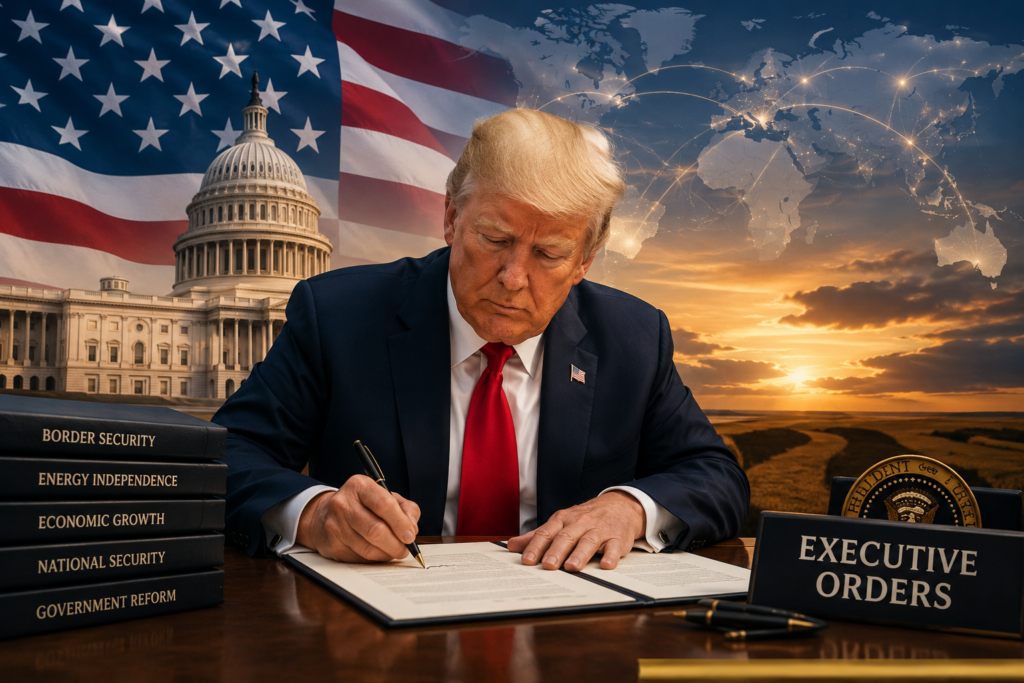
An executive order is a formal directive issued by the President of the United States to federal agencies and officials. It carries the force of law within the executive branch, meaning it does not require a vote from Congress to take effect. However, it can be challenged in federal courts and overturned by future presidents.
Executive orders have been used by every U.S. president since George Washington. But their frequency and scope vary enormously. In his second term, Trump has used executive orders as one of his primary tools of governance — reshaping policy on dozens of fronts at a speed that has surprised even his allies.
Day One: The Orders That Changed Everything Immediately
Trump’s first day back in office was historic in terms of executive action. He signed more orders on January 20, 2025, than most presidents sign in an entire month.
Among the most impactful were:
Rescinding 78 Biden-era orders. In a single stroke, Trump revoked dozens of executive orders signed by his predecessor, dismantling Biden’s climate commitments, diversity programs, and immigration policies. The breadth of this reversal was unprecedented in modern U.S. history.
Withdrawing from the Paris Climate Agreement. For the second time, Trump signed an order pulling the United States out of the landmark international climate deal. The withdrawal signaled to the world that the U.S. would not be bound by global emissions targets, triggering criticism from European allies and climate scientists.
Withdrawing from the World Health Organization. Trump signed an order formally removing the U.S. from the WHO, the United Nations’ global health body. The move raised serious concerns about international disease surveillance and pandemic preparedness, given that the U.S. had been one of the WHO’s largest funders.
These three orders alone sent shockwaves through the international community — and the second term had only just begun.
Immigration: The Most Aggressive Crackdown in Modern History
Immigration has been at the center of Trump’s second-term agenda, and executive orders have been the primary vehicle for delivering on his campaign promises.
Key immigration orders include:
“Protecting the American People Against Invasion” (EO 14159) expanded the use of expedited removal, allowing immigration authorities to deport individuals without a court hearing in many cases. It also directed the federal government to cut funding to so-called sanctuary jurisdictions — cities and states that limit cooperation with federal immigration enforcement.
Enhanced vetting of visa applicants was ordered across all federal agencies, significantly raising the bar for foreign nationals seeking to enter the United States. Legal experts noted that the policy would affect students, workers, and tourists from dozens of countries.
The suspension of the U.S. Refugee Admissions Program (USRAP) halted the resettlement of refugees in the United States, with exceptions only on a case-by-case basis. Human rights organizations described the move as a dramatic step backward for American humanitarian leadership.
These orders have had real consequences: immigration courts have been overwhelmed, legal challenges have stacked up in federal courts, and communities across the U.S. have seen sweeping enforcement operations.
Trade and Tariffs: Rewriting the Rules of Global Commerce
Perhaps nowhere has Trump’s second term been felt more broadly than in international trade. Using an aggressive interpretation of presidential trade authority, Trump implemented one of the most sweeping tariff regimes in modern U.S. history.
By February 2026, Trump had issued 38 executive orders, 4 memoranda, and 10 proclamations specifically related to trade and tariffs — touching everything from steel and aluminum to semiconductors and pharmaceuticals.
His stated philosophy was clear from day one: instead of taxing American citizens, he would tax foreign countries. In practice, this meant steep tariffs on imports from China, the European Union, Canada, Mexico, and many other trading partners.
The effects rippled across the global economy:
- Consumer prices in the U.S. rose on goods ranging from electronics to cars.
- Retaliatory tariffs from trading partners hit American farmers and manufacturers.
- Brazil was targeted with a proposed 25% tariff on goods in June 2026, straining bilateral relations.
- The Supreme Court weighed in, ruling in February 2026 that the legal basis Trump used for some tariffs — the International Emergency Economic Powers Act — did not actually authorize the imposition of tariffs. The ruling was a significant legal setback, though its practical impact remained contested.
Energy and the Environment: Drilling Into the Future
Trump’s energy policy made a dramatic U-turn from the Biden era. A series of executive orders directed federal agencies to expand fossil fuel production, roll back environmental regulations, and open previously protected lands to resource development.
Notable actions included:
“Unleashing Alaska’s Extraordinary Resource Potential” directed agencies to rescind restrictions on oil, gas, and mineral development in Alaska — including the Arctic National Wildlife Refuge, a region long protected by environmental advocates.
Strengthening coal power generation was another key move, with an order specifically promoting the use of coal as part of national defense energy strategy — a reversal of the broader global trend away from coal.
Semiconductor and critical minerals tariffs were introduced in early 2026, framing resource and technology access as a matter of national security — with significant implications for global supply chains.
The Global Ripple Effect: How the World Is Reacting
Trump’s executive orders have not occurred in a vacuum. Their effects are being debated in capitals from Brussels to Beijing, from Brasília to Seoul.
Europe has responded with a mix of frustration and adaptation. The EU accelerated its own strategic autonomy initiatives, reducing dependence on U.S. military and trade commitments. The Paris Agreement withdrawal has deepened the transatlantic rift on climate.
China has matched U.S. tariffs with countermeasures of its own, intensifying what analysts describe as a structural decoupling between the world’s two largest economies.
Latin America has seen new pressures, with countries like Brazil facing trade threats that complicate longstanding economic ties with the United States.
Global health institutions have scrambled to fill the funding and coordination gaps left by the U.S. withdrawal from the WHO.
The broader question being asked in foreign ministries around the world is: can U.S. foreign policy — reshaped so dramatically by executive order — be trusted to hold across future administrations?
Controversy and Legal Challenges
Not all of Trump’s executive orders have survived legal scrutiny. Federal courts have blocked, delayed, or modified several of the most controversial directives.
The Supreme Court’s February 2026 ruling on tariff authority was a landmark moment, establishing limits on how far a president can stretch trade law. Other courts have weighed in on immigration orders, birthright citizenship, and DEI-related directives.
Critics argue that the reliance on executive orders — rather than legislation passed by Congress — creates a fragile legal architecture. Supporters counter that it represents decisive leadership in a polarized political environment where congressional action is difficult.
Both sides agree on one thing: the sheer volume and reach of Trump’s second-term executive actions is historically unusual.
Learn more about Donald Trump’s second Term political career and presidency in this detailed biography.
What Comes Next?
As of mid-2026, Trump’s second term still has more than two years to run. Several key policy areas — pharmaceuticals, artificial intelligence governance, and election integrity — have seen new executive orders in recent months, signaling that the pace of action is not slowing.
Whether these orders will ultimately transform American governance permanently, or be rolled back by future administrations, remains the defining political question of the era.
What is certain is this: executive orders from the Oval Office are no longer just administrative footnotes. They are the main event — shaping economies, borders, alliances, and lives across the globe.
The long-term success of Trump’s Second Term will likely depend on how these executive orders are implemented and received by both Congress and international partners.
Conclusion: A Presidency Defined by the Stroke of a Pen
Trump’s second term has demonstrated, more than any presidency in recent memory, how much a single leader can reshape the world through executive action alone. From climate to trade, immigration to energy, the orders signed in Washington, D.C. carry consequences felt in every corner of the globe.
For readers trying to understand the rapidly shifting world of 2026, keeping track of executive orders is no longer optional — it’s essential.
Want to stay informed about global politics and world events? Explore more in-depth articles on Info Is The Key — your source for clear, reliable, and well-researched content about the world.
Tags: Donald Trump, Executive Orders, U.S. Politics, World News, Trade Policy, Immigration, Climate, Foreign Policy, Second Term
Category: Politics